Contactless Temperature Sensing
Author: Byline
As the world begins to emerge cautiously from the coronavirus pandemic lock-down, shops, offices, and public spaces are becoming accessible again. Some buildings can expect to see more people wishing to enter than others, yet it is crucial to appreciate that, while lock-down restrictions ease, the virus is still with us. Stopping the spread of the virus within indoor public spaces is now a priority, and one reliable and effective way of achieving that is through contactless temperature measurement. Once an infected person enters a building, the risk they will pass on the coronavirus to others increases significantly. With viral transmission occurring through access keypads, touch-controlled kiosks, and door handles, the likelihood is that potentially many hundreds of persons become infected from just one person. Temperature measurement through surface contact is much slower and substantially increases the risk of passing the virus between the tester and those tested. Contactless temperature detection at the point of building entry, using a walk-through scanner, provides a quick and straightforward method of implementing real-time access control. Also, the same approach using hand-held sensors provides a convenient approach for places where fewer people are involved, such as a restaurant.
Another impact of coronavirus is that it is predicted to accelerate innovation in the self-health interactive kiosk market sector. Anyone will be able to check their temperature with ease using a kiosk located in public spaces such as shopping malls, railway and public transit stations, and company reception areas.
Contactless temperature measurement
Contactless temperature measurement relies on the detection of infrared radiation to function. The infrared spectrum lies between the wavelengths of visible light and radio frequencies. William Herschel discovered the infrared spectrum by accident in 1800. It was another one hundred years before Josef Stefan, and Ludwig Boltzmann et al. established the Stefan-Boltzmann law that formed the link between emitted infrared radiation and an object's temperature. Every object above 0 °K can emit infrared radiation, and the detection of it is the first step to determining the object's temperature. Infrared sensors are thermal detectors whose electrical characteristics change when exposed to infrared radiation. There are two principal methods of measuring electrical changes; thermopile and pyroelectric.
A thermopile-based sensor uses the thermoelectrical effects of the junction of two different metallic materials. The thermopile generates a voltage proportional to the junction temperature.
Pyroelectric sensors use a sensing element that coated with a crystalline material that changes polarization with the temperature of the applied infrared light. The changes in polarization result in a corresponding alteration of the electrical charge. The voltage output is proportional to the measured temperature.
Creating an infrared contactless temperature sensor requires a sensing element, typically a thermopile, a reference sensor, and an analogue signal chain. See Figure 1. Some commercially available sensors also include an analogue to digital converter (ADC) and a microcontroller that manages the transmission of the temperature data via an industry-standard serial communication protocol such as I2C. Factory stored calibration coefficients may be used to output temperature readings directly; other sensors may provide linear but raw data points that require further processing by the host application. Other sensors output the analogue voltage derived from the sensing element, which may or may not be calibrated to a reference temperature.
Figure 1 - The construction of a thermopile-based temperature sensor (source TE Connectivity)
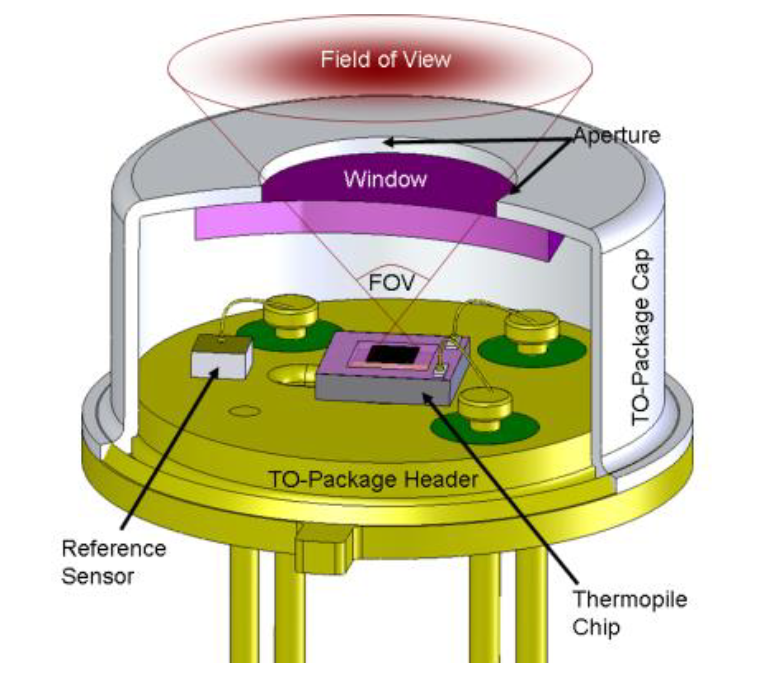
The sensor in Figure 1 highlights the use of an absorber material that is physically separated from the sensor's body and is situated above the thermopile element. An optical arrangement is incorporated within the sensor's sealed body to set the field of view (FoV). The sensor's field of view is an essential aspect of any end-application since it determines the area in which temperature measurement takes place. For contactless measurement of a person's forehead close to the sensor requires a narrow field of view.
Designing a non-contact temperature measurement application
In this section of the article, we showcase three different infrared temperature sensors suitable for use in walk-through access control, kiosk and hand-held applications.
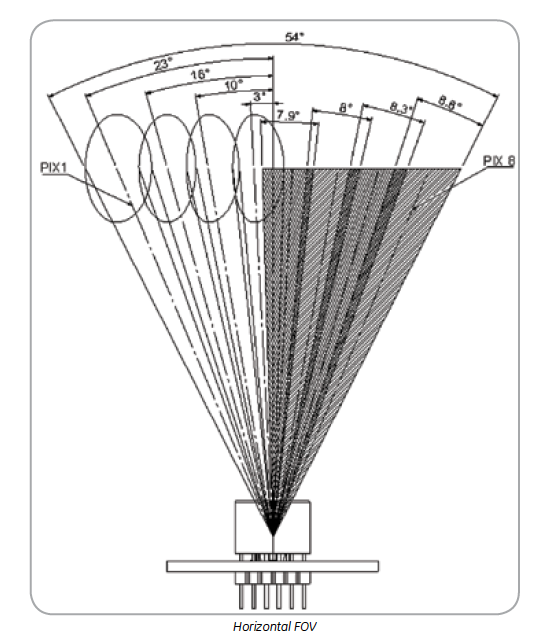
The Amphenol ZTP series includes five different sensors providing a choice of analogue or digital output. Four are constructed in compact TO-46/TO-39 packages, and the fifth, the ZTP-188MA, is a digital sensor module. The field of view is device dependent and spans from 12 degrees to 90 degrees. The ZTP-188MA, for example, is a comprehensive sensor and processing circuit integrated into a compact, low power module measuring 30 mm x 23 mm x 8.50 mm. Operating from a nominal 5 VDC supply, the module output is available via an I2C interface. The sensor comprises a 1 x 8 array of sensor elements, with a total horizontal FOV of 50 degrees, and an individual sensor element pixel of 7 degrees - see Figure 2. The vertical FOV is 14 degrees.
Figure 2 - Horizontal field of view from the Amphenol ZTP-188MA sensor module (source Amphenol)
Temperature resolution is within 0.1 degrees, and the maximum accuracy is +/- 1 degree C. The sensor is fully calibrated and compensated, making for ease of integration into the end system. The maximum target temperature is 40 degrees C. The module provides two slave I2C registers for reading over the bus, 0xA1 to read the object (target) temperature, and 0xB1 the ambient sensor temperature. Data is returned as two bytes, MSB & LSB, which require minimal host processing to derive the measured temperature.
Another offer within the ZTP-Series of thermopiles are non-contact handheld thermometers. An example is the compact, high sensitivity TO-46 packaged ZTP-148SR sensor. Aimed at handheld surface temperature measurement of the forehead and ear, this thermopile IR sensor has a typical field of view of 85 degrees and includes a flat infrared filter and an NTC temperature compensation thermistor within the package.
An example of an analogue infrared temperature sensor is the TE Connectivity G-TPCO-019.
Packaged in a small TO-5 footprint, the single element sensor can operate over an ambient temperature range from - 20 degrees C to + 85 degrees C.
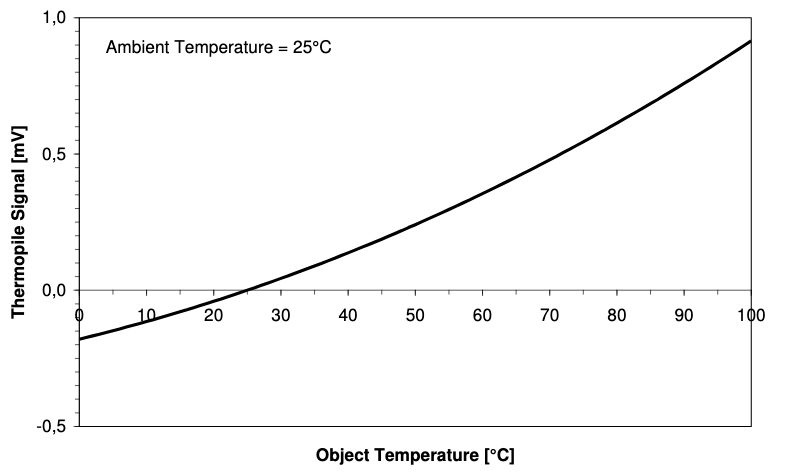
The sensor element outputs 0.9 mV +/- 0.25 mV when the ambient temperature is 25 degrees C, and the target object's temperature is 100 degrees C. See Figure 3. FOV is +/- 10 degrees, making it suitable for use in hand-held scanners and kiosk applications.
Figure 3 - Graph of the output voltage, in mV, from a TE Connectivity G-TPCO series sensor against object temperature. (source TE Connectivity)
The third infrared sensor showcased is the Omron D6T series. The series comprises sensors with a variety of different matrix resolutions including 1x1, 1x8, 4x4, and 32x32. The 1x1 pixel sensor is ideal for use in portable clinical thermometers and the 32x32 is ideal for wide-angle detection over longer distances. The 32x32 pixel sensor, for example, provides a 90 degree by 90 degree detection field which equates to a square field of view of 200 cm x 200 cm. Such a large detection area provides the ability to detect a face within a whole room although the reduced detection precision makes fever detection unreliable over longer distances. However, where a target is up to 100 cm away reliable temperature detection can be achieved even if the face is partially obscured by PPE or safety goggles.
Another example product is the D6T-44L-06 sensor module which incorporates a 4 x 4 element array, reporting a total of 16 pixels over an I2C interface. The D6T 4x4 sensor is capable of measuring face temperature at distances of up to 1 m and is idea for use in access control applications. The module's microcontroller directly outputs compensated temperature readings without imposing the calculation tasks on the host application. See Figure 4.
Figure 4 - Detection area for pixels 0 - 15 from the Omron D6T-44L-06 4 x 4 array thermal sensor (source Omron).
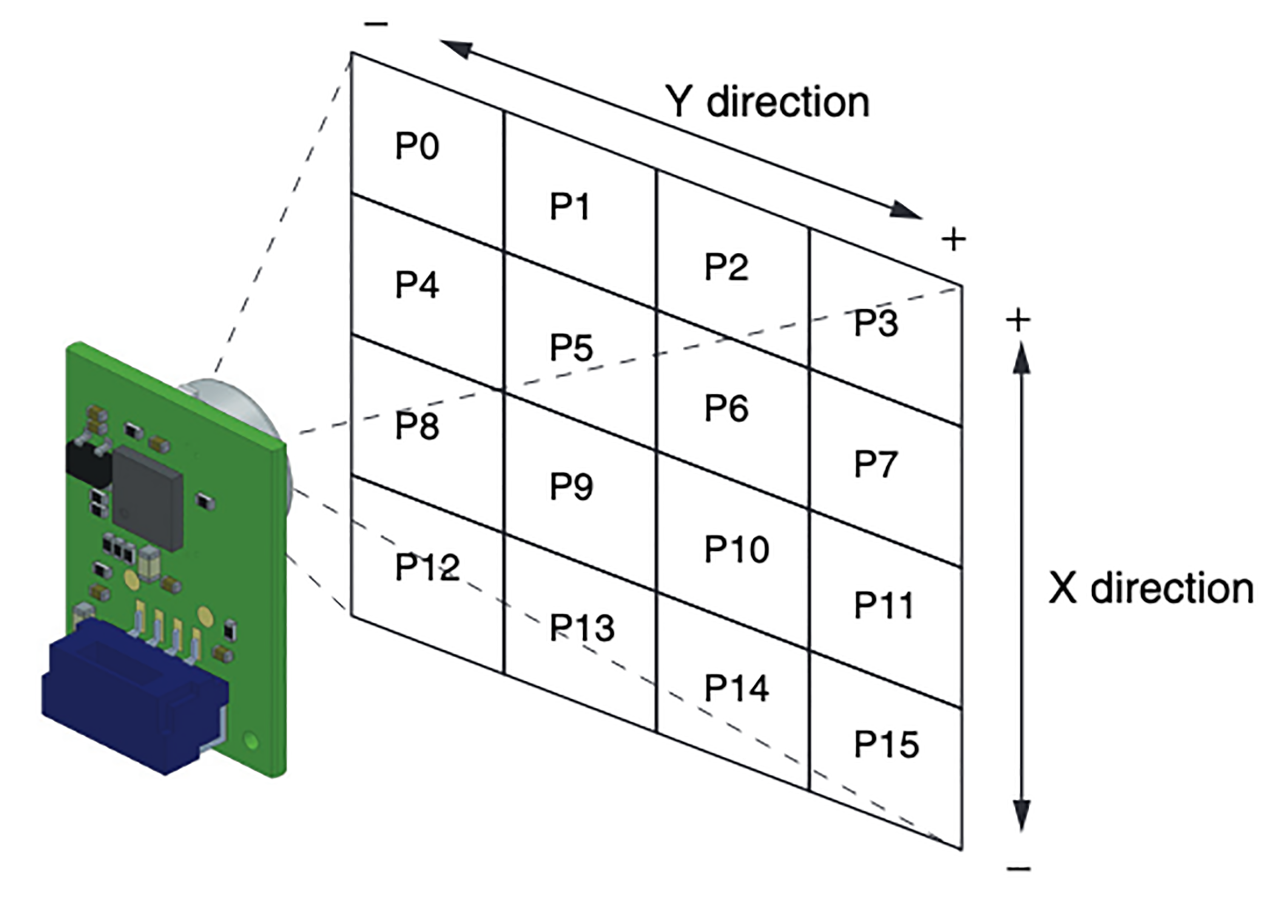
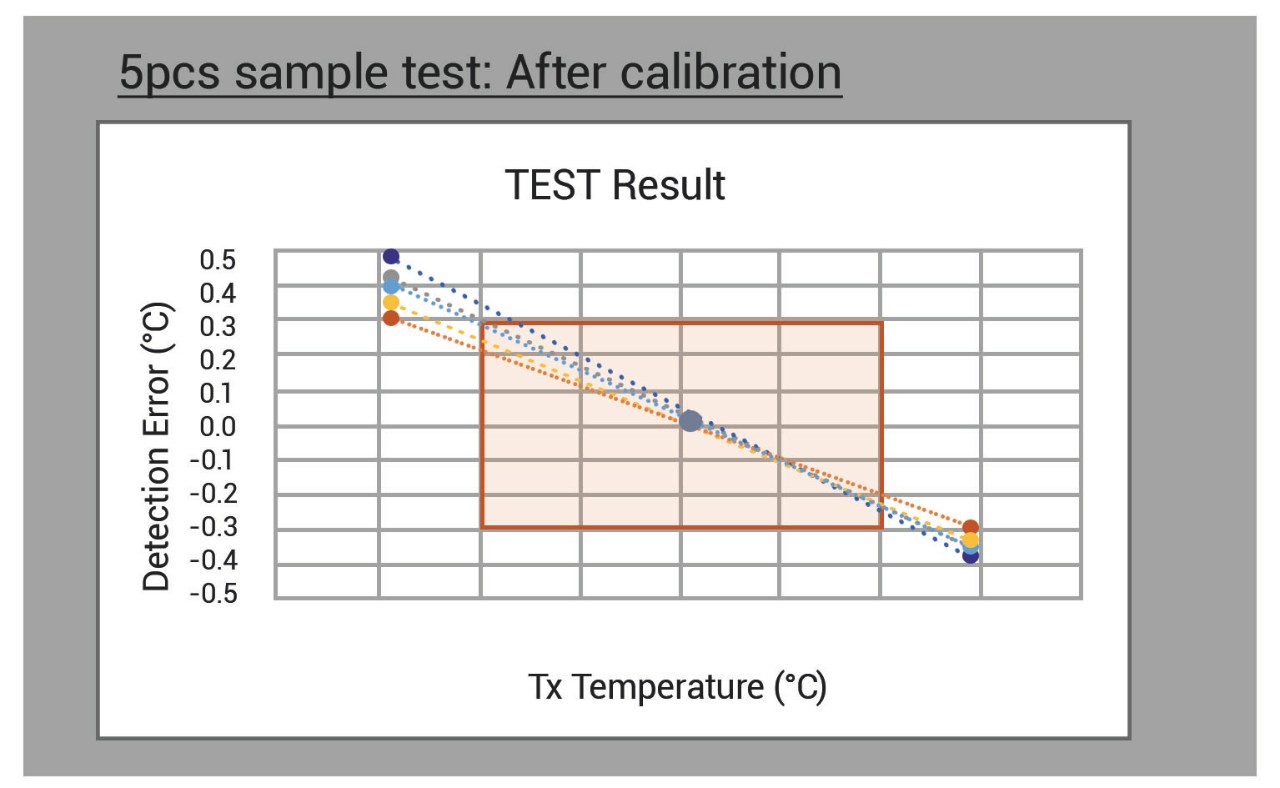
The D6T-44L-06 has a 44.2 horizontal degree FOV and a 45.7-degree vertical FOV. The module operates from a nominal 5 VDC supply and consumes typically 5 mA. The array type of sensing is ideal for walk-through access gate types of applications since it allows the end-measurement application to isolate the person's head from the background. A high measurement accuracy of +/- 0.3 degrees C is achieved through 1-point calibration by the system developer. See Figure 5. With a 2-point calibration technique the D6T 4x4 sensor can achieve a more accurate temperature detection down to +/- 0.2 degrees C, permitting a reliable identification of fever.
Figure 5 - Using a one-point calibration technique to increase temperature measurement accuracy to within +/- 0.3 degrees C over a +/- 2 degrees C range (source Omron)
Conclusion
As the world moves into the next phase of dealing with the coronavirus pandemic, the quick, reliable and accurate measurement of a person's temperature will significantly aid people flow and prevent the spread of the virus in public spaces. Used in conjunction with a gate-style access control system, it will prevent individuals with elevated temperatures from entering a building. Infrared temperature measurement provides a contactless method of achieving this for a variety of contactless solutions. Also, unlike machine-learning, camera-based detection systems, the infrared approach does not raise any data protection concerns since no personally identifiable information is stored.