RF Connectors: A $5 Billion Market
04/30/2025 //
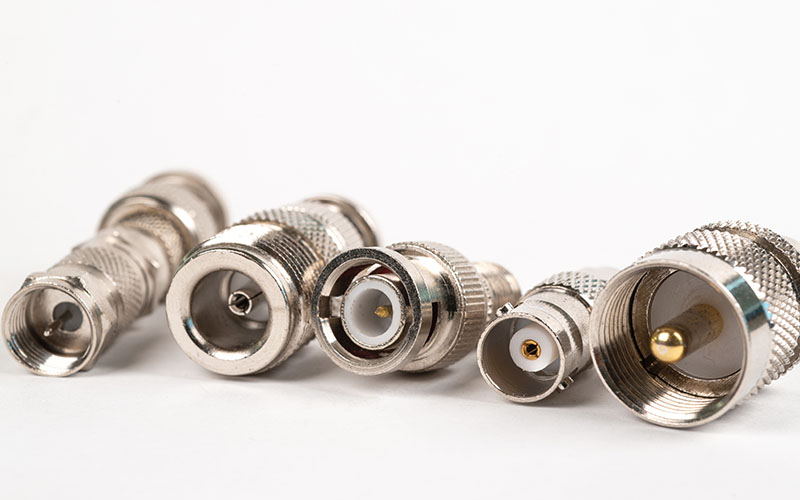
RF coax connectors account for 5.7% of the world connector market. Sales were $4.95 billion in 2024, growing 7.2%. The RF product type is used in all market sectors. China is the largest consumer of RF coax connectors, followed by North America.
The following table sizes the RF market by region of the world.
2023 and 2024 RF Coax Connector Sales by Region of the World with Percent Change and Market Share
| Region | 2023 | 2024 | Percent Change | 2023 Percent Market Share | 2024 Percent Market Share |
| North America | $1,163.6 | $1,249.7 | 7.4% | 25.2% | 25.2% |
| Europe | $1,003.0 | $999.0 | -0.4% | 21.7% | 20.2% |
| Japan | $234.3 | $202.7 | -13.5% | 5.1% | 4.1% |
| China | $1,310.3 | $1,494.3 | 14.0% | 28.4% | 30.2% |
| Asia Pacific | $653.2 | $790.3 | 21.0% | 14.1% | 16.0% |
| ROW | $257.4 | $218.2 | -15.2% | 5.6% | 4.4% |
| Total World | $4,621.8 | $4954.2 | 7.2% | 100.0% | 100.0% |
| $ Millions | © 2025 Bishop & Associates, Inc. | ||||
In 2023, the Chinese market accounted for 28.4% of all RF coax connector sales, and in 2024, this percentage increased to 30.2%. It is anticipated that China will continue to hold this position in 2025, with Asia Pacific once again growing substantially. For information on how to obtain a complete 2025 and 2030 forecast for all connector product types, market sectors and regions as presented in the 2025 World Connector Handbook.
The automotive market saw the greatest increase, growing 10.9% in 2024 followed by the telecom/datacom market with growth of 9.0%. The least growth was seen by the business/office equipment market where sales declined 2.0%, followed by the medical sector, where sales grew 2.3%. It is anticipated that in 2025, all market sectors will experience growth.
The following table segments RF sales by market sector.
2023 and 2024 RF Coax Connector Sales by Market Sector with Percent Change and Market Share
| Market Sector | 2023 | 2024 | Percent Change | 2023 Percent Market Share | 2024 Percent Market Share |
| Computers & Peripherals | $508.1 | $535.8 | 5.5% | 11.0% | 10.8% |
| Business/Office Equipment | $30.7 | $30.1 | -2.0% | 0.7% | 0.6% |
| Instrumentation | $247.2 | $263.2 | 6.5% | 5.3% | 5.3% |
| Medical | $278.3 | $284.8 | 2.3% | 6.0% | 5.7% |
| Industrial | $558.6 | $586.8 | 5.0% | 12.1% | 11.8% |
| Automotive | $717.9 | $793.6 | 10.9% | 15.5% | 16.1% |
| Transportation | $173.1 | $183.6 | 6.1% | 3.7% | 3.7% |
| Military/Aerospace | $2,26.1 | $238.1 | 5.3% | 4.9% | 4.8% |
| Telecom/Datacom | $1,585.1 | $1,728.4 | 9.0% | 34.3% | 34.9% |
| Consumer | $122.6 | $128.2 | 4.6% | 2.7% | 2.6% |
| Other Equipment | $174.1 | $178.7 | 2.6% | 3.8% | 3.6% |
| Total World | $4,621.8 | $4,954.2 | 7.2% | 100.0% | 100.0% |
| $ Millions | © 2025 Bishop & Associates, Inc. | ||||
In 2023 and 2024, the telecom/datacom market sector accounted for the greatest market share percentage, capturing 34.3% of the total RF coax market in 2023 and 34.9% in 2025. The telecom/datacom market was followed by the automotive market with 15.5% in 2023 and 16.1% in 2024.
Exploring the growth behind this dynamic product type is Bishop & Associates’ newest market research report, World RF Coax Connector Market 2025. RF coax interconnects are essential components in expanding technologies such as 5G and IoT and have widespread use in mil/aero, industrial and other programs that involve RF, microwave, mmWave and THz frequencies.
This new report presents past data (2022 and 2023), recent performance (2024) and future (2025 and 2030) sales results and forecasts by primary RF connector type, as shown in the product type listing below.
| Primary RF Family | Connector Series (Family Grouping) | |
| Ultra-Microminiature | U.FL, MHF, MH4, X.FL, K.FL2, UMCC, AMC, UMP | |
| Microminiature | MCX, MMCX, QSL, SuperMini 0.9 mm, MOEBIUS | |
| Subminiature | QMA, SMA, SSMA, SMB, SSMB, SMC, SSMC, SMD, FAKRA, mini-FAKRA, 1.0/2.3, 1.5/3.5, 1.6/5.6 | |
| Miniature | BNC/Mini BNC/HD-BNC, UHF/Mini-UHF, MHF, SHV, F, G, 2.2/5 | |
| Medium | TNC/RP-TNC, N, QN, HN, ZMA, SMPKey, 4.3/10, 4.1/9.5 Mini-DIN, NEX10, QLI | |
| Large | DIN 7/16, 13/30, L, C, SC, LC, LT | |
| Precision | 7mm, 3.5mm, 2.92mm, 2.40mm, 1.85mm, 1mm, 0.9mm, 0.8mm, 0.6mm | |
| Blindmate | BMA (OSP), BMMA (OSSP), SBMA, BZ, BMZ | |
| Board-to-Board | SMP (GPO), SMPM, SMP3, IMP, MMBX, MBX, SSBB, Compression Types | |
Also included in the report are details on the newest coax connector product developments, from the smallest MHF to higher frequency 1.35 mm, 0.8 mm and 0.6 mm connectors. It also includes information on related industry standards, including IEEE-287-2021, MOSA, VITA and MIL-Spec revisions, with application discussions and reviews of primary suppliers. The report highlights the importance of miniaturization and higher frequency capabilities, with connectors now operating above 145GHz and addresses the billion-dollar waveguide market, a market that has proven to be essential for high-speed data transmission, communications and IoT applications, which span military, aerospace, medical and industrial sectors.
5G communications are set to take advantage of newly redefined E-Band for backhaul transmission using microwave connectors performing to 90GHz, while also expanding sales for lower frequency low PIM and standard connectors such as 7/16, N and NEX10. 5G and IoT mobile devices will expand demand for automated production (and automated pick-and-place installation) of micro-miniatures such as U.FL, X.FL, MHF, mini RF PCI and miniatures such as MMCX, primarily for operation under 6 GHz.
The report also highlights the significance of international suppliers and standards with an illustrated section on the Next Generation Mobile Networks (NGMN) Alliance of the MQ4/MQ5 cluster connector developed by Huawei for 5G cluster antenna interface.
Topics discussed in this report include:
- How did the RF coax connector market perform in 2024? How will the RF connector market perform in 2025 and in 2030? What industries and geographical regions present the greatest potential for growth in RF (coaxial) connectors and why?
- How do new and higher frequency allocations, especially for 5G/6G and IoT, influence design, production tolerances, test equipment and cost and supply chain sourcing? What is the role and how does this role affect the demand for waveguides? Are all waveguides alike? What sets them apart from other RF products?
- Which specific RF coax connectors (families and product types) are projected to show the greatest growth over the forecast period? In areas of slower growth, what has precipitated this slowdown in growth? Is it the introduction of new products or increased variations of existing products?
Projected to have the second highest growth rate of all connector types, with a CAGR of 9.0%, for the period 2025 to 2030, the RF coax connector market is anticipated to undergo major changes. These predictions include the effects of trends for higher frequencies, broader application bandwidths and international shifts.
For a detailed table of contents and ordering information for World RF Coax Connector Market 2025, click here.
Follow TTI, Inc. on LinkedIn for more news and market insights.
Statements of fact and opinions expressed in posts by contributors are the responsibility of the authors alone and do not imply an opinion of the officers or the representatives of TTI, Inc. or the TTI Family of Specialists.
Follow TTI, Inc. - Europe on LinkedIn for more news and market insights.
Statements of fact and opinions expressed in posts by contributors are the responsibility of the authors alone and do not imply an opinion of the officers or the representatives of TTI, Inc. or the TTI Family of Specialists.
Search MarketEYE
Filter Articles By Category
TTI Insights
Stay Updated
Keep up with the latest news, product introductions, tech videos, and more.