Wireless Charging Standards Open the Door for Autonomous EVs
12/23/2024 //
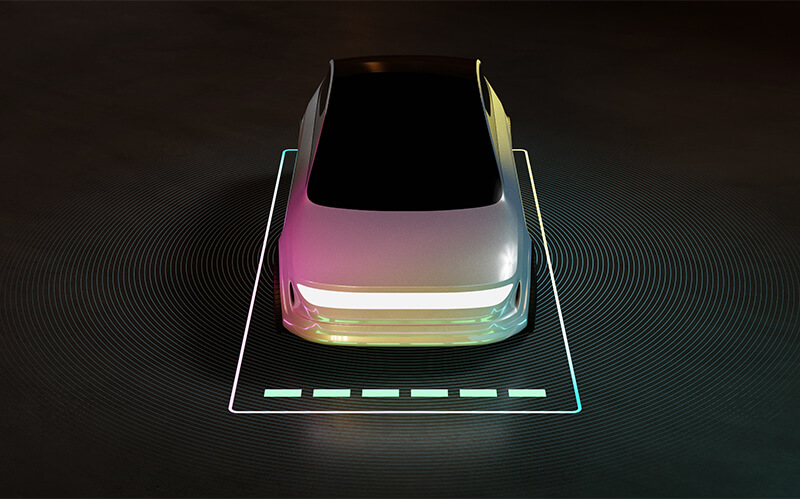
Today, the end user experience for charging an electric vehicle includes the need to handle a connector and cable. But if champions of wireless technology have their way, charging your EV will become as simple as parking your car and walking away. Just like wireless charging of your smartphone.
For wirelessly charging an EV, a conduit runs from the power box onto the floor and into a charging pad. When the vehicle parks over the pad, charging starts, providing an electric vehicle with greater range without the need for a physically connected cable.
The wireless charging standard J2954 aims to facilitate the process safely and automatically. First published in 2020 by the Society of Automotive Engineers (SAE), SAE J2954 defines a unidirectional wireless charging system for light-duty EVs. It specifies wireless power transfer (WPT) in three charging speeds at a maximum of 3.7 kW, 7.7 kW and 11 kW, respectively.
SAE J2954 paves the way for electric vehicle charging without a plug and enables alignment for manual or even autonomous parking. Standardizing wireless charging for EVs is important for numerous reasons, among these are:
- It allows EVs to be compatible with various wireless charging pads, eliminating the need for multiple proprietary technologies.
- It defines the acceptable tolerance for aligning the ground coil and the vehicle coil.
- It enables people to wirelessly charge their cars in different regions without having to worry about knowing which charger to use.
- It encourages greater adoption of EVs.
- The standard enables selection of a charging rate based on vehicle requirements,
- It defines grid-to-battery efficiency (in this case up to 94%).
WPT following SAE J2954 establishes an industry-wide specification for private (fleet) and public wireless power transfer, including for charging electric vehicle batteries.
It further defines acceptable criteria for interoperability, electromagnetic compatibility, EMF, minimum performance, safety and testing.
A higher performance level designated WPT9 is being defined in standard J2954/2 for up to 500kW charging for heavy-duty vehicles, which have the room needed to mount a larger induction plate.
J2954 addresses stationary charging. In future, wireless charging will allow vehicles to charge as they move, potentially further boosting their range. Dynamic charging applications are to be specified in SAE J2954/3.
Wireless charging is based on inductive power transfer, so named because it transfers energy through inductive coupling. Initially, alternating current passes through an induction coil in the charging station or pad. The moving electric charge creates a magnetic field, which fluctuates in strength as the electric current's amplitude is fluctuating. This creates an alternating electric current in the device's induction coil, which in turn passes through a rectifier to convert it to direct current. Finally, the direct current charges a battery or provides operating power
The J2954 system consists of two parts, a charger station and its associated induction pad, known as the ground assembly (GA) and the vehicle-mounted section known as the vehicle assembly (VA). In the GA’s power transfer coil, a magnetic field is generated which induces a voltage in the VA power transfer coil. The GA connects to the grid, changing the grid power from alternating current (AC) to direct current (DC) using a conventional rectifier.
The VA then charges the batteries directly. This means that a different receiver is needed for each vehicle, as battery-pack voltages and charging systems vary widely. The GA also contains a Bluetooth-based communications system that it uses to communicate with the charger on the car to determine maximum rate of charge and charge state. Triangulation sensors on the car indicate the proper positioning of the car over the charger pad.
Greater distances between sender and receiver coils can be achieved when the inductive charging system uses resonant inductive coupling, where a capacitor is added to each induction coil to create two circuits with a specific resonance frequency. Resonant coupling occurs when the natural frequencies of two systems — a source and a receiver — are approximately the same. As a result, you can get very high-efficiency charging.
The system is said to be very safe: foreign object detection can determine whether there's metal object in the way and will shut things off if anything were to get in between the sender and receiver coils.
The system uses a reliable way of aligning the vehicle so that it is on top of the pads at all times. Called differential inductive positioning (DIPS) for short, it is basically an auxiliary small coil. By adopting the idea of leaving the otherwise-idle GA induction coil powered at a very low level, multiple sensors in the VA can use this signal to triangulate the pad and display targeting information to the driver so the driver has information about proper alignment of the vehicle. The DIPS transmitter and receiver coils can be fully integrated into the GA and VA.
The standardized alignment method DIPS makes it easy to create a seamless, all-weather system (a magnetic field doesn't really see snow and ice as it goes right through so the system will work in non-perfect weather conditions).
The Seattle area is set to purchase zero-emission Enviro500EV buses, featuring an inductive charging system produced by InductEV. The procurement includes 48 wirelessly charging electric buses powered by 13 300-kW in-ground inductive chargers. When a wireless charging-equipped bus stops over charging pads placed in the roadway, it connects via an inductive magnetic resonance system.
Follow TTI, Inc. on LinkedIn for more news and market insights.
Statements of fact and opinions expressed in posts by contributors are the responsibility of the authors alone and do not imply an opinion of the officers or the representatives of TTI, Inc. or the TTI Family of Specialists.
Follow TTI, Inc. - Europe on LinkedIn for more news and market insights.
Statements of fact and opinions expressed in posts by contributors are the responsibility of the authors alone and do not imply an opinion of the officers or the representatives of TTI, Inc. or the TTI Family of Specialists.
Murray Slovick

Murray Slovick is Editorial Director of Intelligent TechContent, an editorial services company that produces technical articles, white papers and social media posts for clients in the semiconductor/electronic design industry. Trained as an engineer, he has more than 20 years of experience as chief editor of award-winning publications covering various aspects of consumer electronics and semiconductor technology. He previously was Editorial Director at Hearst Business Media where he was responsible for the online and print content of Electronic Products, among other properties in the U.S. and China. He has also served as Executive Editor at CMP’s eeProductCenter and spent a decade as editor-in-chief of the IEEE flagship publication Spectrum.
Search MarketEYE
Filter Articles By Category
TTI Insights
Stay Updated
Keep up with the latest news, product introductions, tech videos, and more.