Mining the Wind: Capacitor Technology Makes Wind Power An Efficient Reality
03/11/2021 //
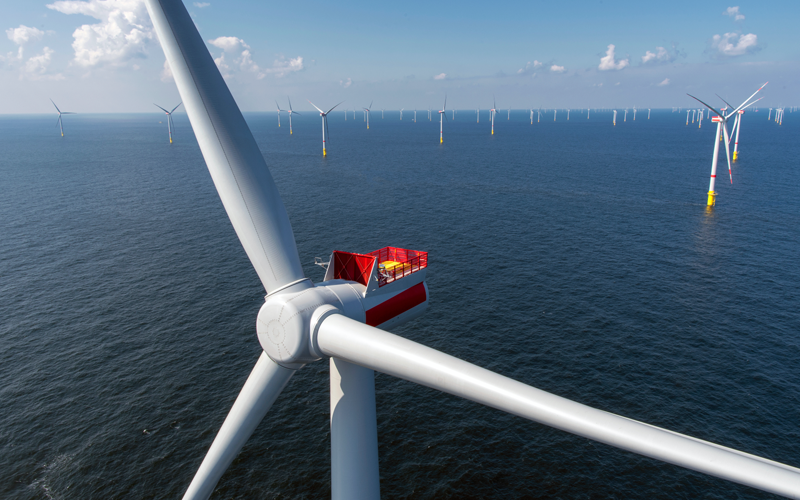
The best wind resources are located offshore. Far offshore, in fact. And the process of harnessing that resource efficiently is being enabled by the effective transference of energy hundreds of miles with minimal losses, using advanced capacitors for power factor correction along the way.
This article describes the emerging market for high voltage direct current (HVDC) capacitor solutions, including how age-old dielectric film + fluid technology is giving way to dry-type, compact capacitor solutions to fit the designs of state-of-the art static converter manufacturers – companies looking to solve the technical riddle of moving large amounts of wind energy long distances without losses.
Mining the Wind
Paumanok research reveals that global wind generation will increase 385 percent between 2020 and 2025, growing from 13 gigawatts of installed capacity to 63 gigawatts.
This is a significant growth rate, and it will have a positive impact on key capacitor manufacturers and materials suppliers in Germany, Italy, Finland, Japan, China and the U.S. Many capacitor manufacturers and materials suppliers supporting HVDC markets worldwide realized a significant increase in demand in CY 2020 to support government incentive programs in China.
Based on a detailed analysis of global HVDC projects by country, Paumanok estimates that between 2021 and 2025 the opportunities for capacitor sales will be primarily in Europe, but with substantial market opportunities emerging in the Americas and Asia during this time-period as well.
Paumanok makes a longer-term outlook for capacitor consumption based upon planned government goals for wind energy by region (based upon guidance from recognized industry associations and wind trade companies). Therefore, by 2030, Paumanok estimates that global wind energy generation will reach 143 GW, an increase of an additional 127 percent over 2025 estimated global wind energy generation of 63 GW.
We conclude that this is a sustainable growth market for dry-type metallized plastic film capacitors between 2021 and 2030. Moreover, the adoption of new technologies, such as segmented dielectric polypropylene film and polymer impregnation of dielectric fluids to replace larger oil-filled cans, is creating new market opportunities for manufacturers of electrical capacitors worldwide.
High Voltage Power Factor Correction Film Capacitor Markets
High voltage polypropylene capacitors have been used for power factor correction of the electrical grid in utility grade power transmission and distribution applications since 1954 (although impregnated high-voltage paper capacitors used for this application can be traced back to 1876). Capacitors are applied directly to the power grid to increase the efficiency of the power factor to limit overall energy losses in the system. Capacitors become enabling technology when long distances between generation and consumption (hundreds of miles) are involved.
Paumanok has researched the power film capacitor market for 34 years and describes the market as unique in the capacitor industry because it is largely “captive and enclosed” among the large turn-key vendors of power T&D equipment.
In Europe, however – and especially in Germany – we note that some of the smaller polypropylene film capacitor manufacturers have been experiencing unique opportunities for power transmission and distribution contracts that we have not seen elsewhere in the world. Smaller manufacturers of power film capacitors catering to peripheral markets (power supplies, welding, furnace and traction markets) have developed dry-type ultra-compact solutions for these applications that are helping expand the viability and success of long-distance high voltage direct current transmission of offshore wind energy.
The Trend from HVAC to HVDC in Power Transmission
Transmission is accomplished at a high voltage to achieve maximum efficiency. High voltage alternating current (HVAC) has been the historically preferred method for transmission purposes because high voltage, and voltage transformation are both easily achieved by means of a transformer.
To meet the growing demand for electricity, power utilities are improving system performance by interconnecting renewables to the grid and balancing the system load. Most importantly, it is not economically feasible to use HVAC transmission technology when long transmission lines (>300 miles) are involved due to voltage instability and higher transmission losses. Using high voltage direct current for transmitting power over long distances helps solve these problems.
A Real Market Opportunity for Capacitor Suppliers
In the spirit of TTI MarketEYE, we identify this as a growth market for component manufacturers and for vendors of polypropylene feedstocks, films and metallization. HVDC transmission is used for improving power transmission efficiency and enhancing the interconnection of asynchronous grids.
Between 2021 and 2030, more HVDC systems will be constructed to take advantage of offshore wind. Heavy and steady winds can be found at sea with distances to shore of more than 300 miles. This resource will be exploited between 2021 and 2030 using HVDC.
Polypropylene capacitors will be an important part of these HVDC systems for power factor correction along long-distance power lines. What’s more, improvement in volumetric efficiency of capacitors and longer lifetimes of the capacitors are enabling smaller static convertors that are more easily installed in harsh environments.
The primary objective of using HVDC transmission is summarized as follows:
- Bulk power transmission – greater than 300 miles.
- Connection of asynchronous systems (interconnects) – allows transfer of power between grid systems running at different frequencies. Half of compact metallized capacitor demand between 2021 and 2030 in HVDC will be for interconnects where power factor correction is required.
- Offshore wind farm integration – simplifies bulk power transfer from offshore wind farms to large load. This trend drives demand for capacitor technology improvement – smaller, lighter capacitors for offshore installation.
Market Leadership in Capacitor Design for HVDC
Based upon Paumanok’s detailed research analysis into all global product lines being consumed for power transmission and distribution, we note that the global market is divided into capacitor cells, modules and racks, with each level of consumption increasing value and profitability.
Paumanok also notes that basic entry into the segment requires the ability to produce 450-volt, 900-volt and 1,500-volt capacitor cells (individual capacitors packaged in large, robust aluminum casings that are easily mounted into modules, which in turn are easily mounted into racks).
Market differentiation has recently emerged in the area of capacitance per cell, which for polypropylene dielectrics has traditionally been very small and, in the case of metallized polypropylene, less than 1,000 microfarad. However, the clear market leaders in the technology, centered in Europe, are now offering compact capacitor solutions that have capacitance values from 6,500 to 30,000 microfarads, vertically integrated and sold in modules that fit into racks.
The top vendors of polypropylene capacitors that serve the high voltage power transmission and distribution market segment have developed “dry-type” capacitors that replace dielectric fluids with solid polyurethane resin fillers. The smaller capacitor design enables production of capacitor modules that are 20 percent smaller in size than oil-filled capacitor designs. These smaller capacitor banks allow for a more compact static converter design which is important for distributed power systems that can run for hundreds of miles.
HVDC Project Analysis: 2021-2025
Major projects in HVDC have been underway in Northern Europe (including the BorWin3, Endrup, Les Mandarin, Huagsneset, Grand Ue, Bruges, Brentwith and Vise projects; China (the massive Wudongde project, which is consuming many of the world’s compact PP dry-type film capacitors in 2020/2021); Africa (in Ethiopia/Kenya); India (Ralgarth-Pugalur); and Japan (Hokkaido), just to name a few.
Cable lengths are the determining factor in the use of HVDC transmission and interconnecting technology. As for equipment sales, including capacitors, demand is also motivated by government tax incentives in China (basically amounting to 0.85 RMB/kWh) which will expire in 2021 – thus capacitor sales to China to support an expected boost of 4.5 gigawatts of HVDC-generated energy boosted the market in 2020.
This incentive has hurried the sale of various types of sub-assemblies for the massive Wudongde project (1,489 km) and minor Sheyang projects. There is also growing demand from Europe, which will aggressively pursue harvesting offshore wind resources from 2021 through 2025; current projects in Norway and Germany exceed 500 km in cable lengths.
Many of the European projects will be at 320kV, while China’s projects will span from 250kV for Sheyang to a massive 800kV for Wudongde, which is required given the distance involved from power generation to consumption.
The Next Push: North America, 2025
While growth in European countries will be rapid and sustainable through 2024, major HVDC projects are planned in North America for 2025. Equipment purchases, including capacitors, will begin to overlap in 2023 as this market gains global traction in multiple regions simultaneously; with major HVDC projects planned for Port Washington, Perce Canada; Iowa to Illinois; Wyoming to Nevada; and Kansas to Indiana.
Paumanok Publications, Inc. anticipates a large increase in U.S. metallized polypropylene capacitor demand to support the 11,000 megawatts expected to be produced in CY 2025 in the Western U.S. and Canada.
Long-Term Outlook: 2026-2030
The various climate action plans put into place in Europe, Asia and America will require additional investments in HVDC and interconnects through 2030. Ambitious plans in the United Kingdom, for example, coming from the UK Committee on Climate Change and Scotwind call for 40GW of wind energy each by 2030, for a combined 80 GW.
Meanwhile, the German Offshore Wind Act calls for 20GW by 2030 and the French Multinational Energy Act requires 8.75GW for offshore wind by 2030. The Denmark Climate Action Plan requires 5GW of energy to come from offshore wind by 2030.
North America, Canada and the United States have ambitious plans for offshore wind generation between 2025 and 2030. Canada alone plans to add 23GW of offshore wind energy, while in the U.S. an additional 17GW will be installed with projects in New York, New Jersey, Massachusetts, Virginia, Connecticut and Maryland. Virginia’s offshore wind generation plan is the most ambitious, with plans to add 5.2GW of offshore capacity by 2030.
Japan, Korea and Taiwan, respectively, have plans to install substantial amounts of offshore wind energy between 2025 and 2030, with Korea adding 12 GW, Japan adding 10GW (in four wind zones – Aomori, Akita, Niigata and Nagasaki) and Taiwan adding 10.5 GW by 2030.
To summarize the overall growth expectations for offshore wind power generation, Paumanok calculates that total offshore wind generation will increase from an estimated 34GW in 2021 to 100GW by 2025, and to 235GW by 2030.
Summary and Conclusions
Each gigawatt installed will require thousands of capacitors that have been placed into modules to achieve the desired voltage and capacitance. Those modules are placed into racks to support the large voltages required in long-distance power solutions.
These capacitors will be “dry-type” compact solutions, mounted in racks that are 20 percent smaller in size than comparable oil-filled designs. Thousands of these robust capacitors, each requiring an operational life of 200,000 to 300,000 hours, will be installed in static converters to correct the power factor of the energy transmitted so that the overall system design experiences limited losses.
In the case of HVDC power transmission from abundant offshore wind resources, expect metallized polypropylene dry-type capacitor demand to grow in a rapid, sustainable way to support planned offshore wind projects, and to support long-term government goals for offshore wind generation and sustainable energy.
Statements of fact and opinions expressed in posts by contributors are the responsibility of the authors alone and do not imply an opinion of the officers or the representatives of TTI, Inc. or the TTI Family of Companies.
Dennis M. Zogbi

Dennis M. Zogbi is the author of more than 260 market research reports on the worldwide electronic components industry. Specializing in capacitors, resistors, inductors and circuit protection component markets, technologies and opportunities; electronic materials including tantalum, ceramics, aluminum, plastics; palladium, ruthenium, nickel, copper, barium, titanium, activated carbon, and conductive polymers. Zogbi produces off-the-shelf market research reports through his wholly owned company, Paumanok Publications, Inc, as well as single client consulting, on-site presentations, due diligence for mergers and acquisitions, and he is the majority owner of Passive Component Industry Magazine LLC.
Search MarketEYE
Filter Articles By Category
TTI Insights
Stay Updated
Keep up with the latest news, product introductions, tech videos, and more.