Passive Component Raw Material Index Declines in October 2023
11/10/2023 //
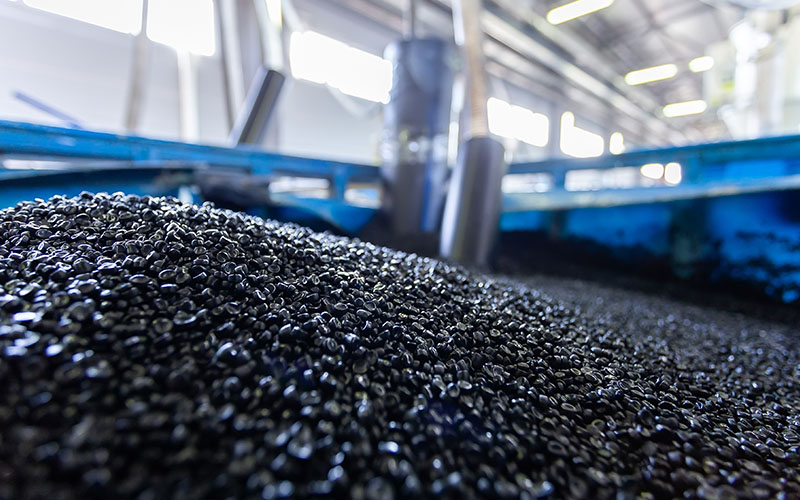
Passive electronic components are raw material intensive. Raw materials consumed in the production of mass-produced surface mount passive components usually come in the form of engineered powders and pastes. These powders and pastes make up the largest variable cost associated with the production of capacitors and resistors. This is why Paumanok Publications, Inc. has tracked the price and availability of specific ceramics and metals consumed as dielectrics and resistive elements for the past 35 years.
The chart below shows the long-term trend in the costs to produce passive components. The trend in October 2023 on a month-to-month basis is down sharply in multiple metals products following months of price variations from global hyper-inflation, choke points in the supply chain and competition amongst industries for
Figure 1.0
Passive Component Raw Material Index: Pricing TREND 2012-2023
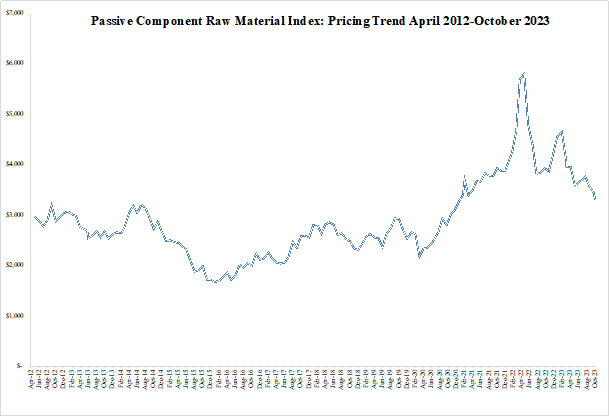
Source: ©2023 “Passive Electronic Components: World Market Outlook: 2023-2028,” Paumanok Publications, Inc. The above chart illustrates aggregate pricing for key feedstocks consumed as the primary dielectric material, resistive element, electrode or termination material for the production of passive electronic components.
How Materials Impact Passive Electronic Component Costs To Produce
Raw materials are the most expensive variable cost associated with the production of passive components. Any fluctuation in price or availability for these key feedstocks can have a negative impact on profit margins. As Figure 1.0 illustrates, raw material prices for passive components have declined in October 2023 following a volatile price trend.
The index shown in Figure 1.0 above is comprised of the following materials:
Nickel
Nickel is the primary electrode material consumed in high capacitance multilayered ceramic chip capacitors (MLCC). The fluctuations in nickel price are primarily the result of competition for the metal with the steel industry, where it is used as a hardener. Nickel supply is in turn important for the production of X5R, Y5V and X7R MLCC, which are the capacitors of choice for the operation of smartphones, tablets and TV sets.
The market has shown extreme volatility from 2021 through 2023 due to supply chain choke points, hyper-inflation and competition for keystone metals consumed in multiple industries seeking to reduce carbon emissions. The price of these dielectric, electrode and termination metals, which are key for all energy storage solutions, is expected to continue to react in 2023. Expect the price of MLCC to follow to absorb any small increases experienced in their nickel electrode paste supply chains.
Figure 1.1: Nickel Price Trend: 2012-2023
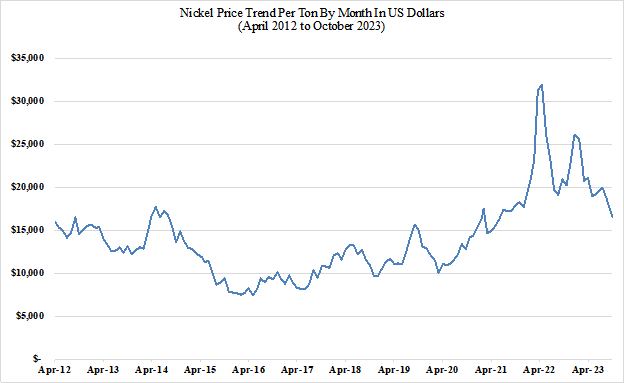
Source: Paumanok IMR “Passive Electronic Components: WMTO 2023—2028.” The chart above illustrates the price trend for nickel ore, which is a keystone material consumed in the multilayered ceramic chip capacitor electrode and a key material for thin film and precision resistive layers.
Copper
Copper engineered powders are consumed in the production of MLCCs as well but as the termination material consumed in conjunction with the nickel type electrode. Therefore, copper and nickel are an important type of base metal duo. Copper is used in some MLCC electrode systems because unlike its counterpart nickel it is non-magnetic. The price of this metal, which is key for energy storage solutions, has showed extreme volatility from 2021 through 2023 due to supply chain problems.
Figure 1.2: Copper Price Trend – 2012-2023
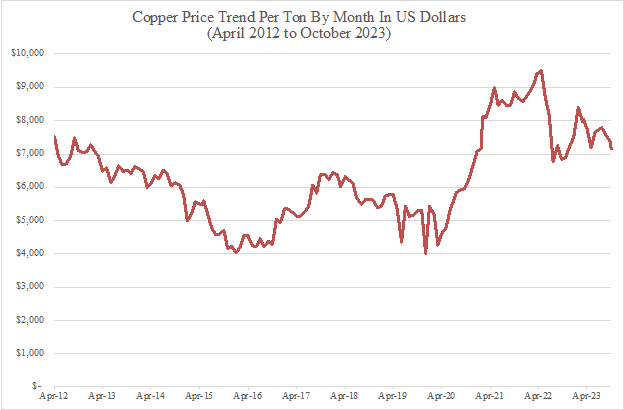
Source: Paumanok IMR “Passive Electronic Components: WMTO 2023—2028.” The chart above illustrates the price trend for copper ore, which is a keystone material consumed in the multilayered ceramic chip capacitor termination matched with nickel electrode and a key specialty electrode material for non-magnetic MLCCs.
Aluminum
Etched anode and cathode foils are consumed as the dielectric layers of aluminum electrolytic capacitors. Aluminum comes from bauxite, which is a mined material. Aluminum is abundant in the Earth’s crust and its price has been historically stable. Aluminum electrolytic capacitors are important components consumed in power supplies, television sets, computers and power electronics, including renewable energy systems. The market has shown extreme volatility in 2021, 2022 and 2023 due to supply chain problems and speculation due to its substantial sourcing of processing in Eastern Europe.
Figure 1.3: Aluminum Price Trend – 2012-2023
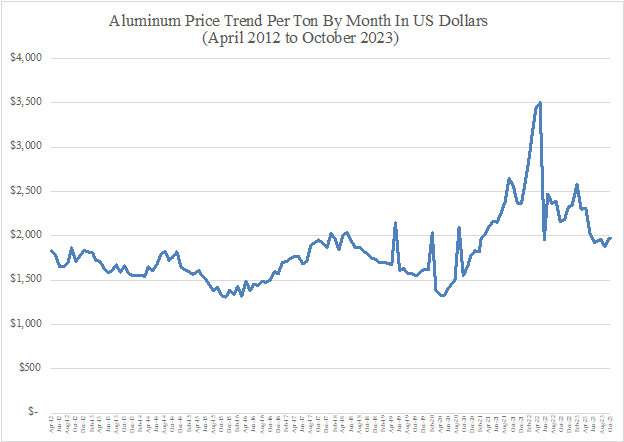
Paumanok IMR “Passive Electronic Components: WMTO 2023—2028.” The chart above shows the price for aluminum ore feedstock, which is a keystone material for aluminum electrolytic capacitor anode and cathode foils as well as a key raw material for resistor substrates along with screw terminal, snap mount and large size power capacitor cans.
Zinc
Zinc is used as an additive in ceramic chip capacitors and as the primary ingredient in the production of metal oxide varistors, which are consumed for circuit protection components in all known AC-line voltage equipment and to protect digital electronics from the effects of electrostatic discharge. The zinc price has been more recently unstable as is shown in the chart below.
Figure 1.4: Zinc Price Trend – 2012-2023
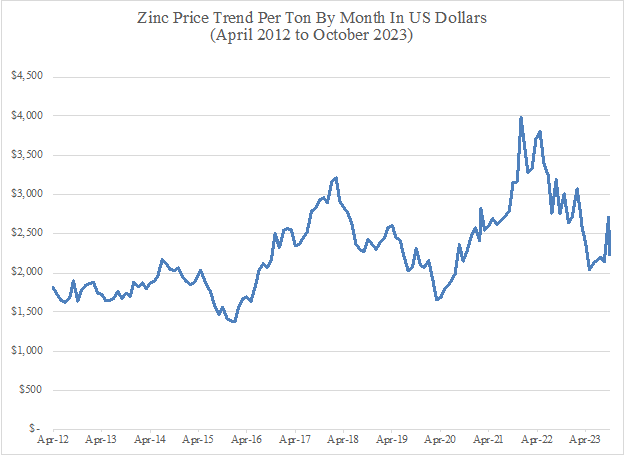
Paumanok IMR “Passive Electronic Components: WMTO 2023—2028.” Zinc is a primary material consumed in non-linear resistor as the active ingredient in zinc-oxide varistors.
Palladium
Palladium is a platinum group metal that is mined in South Africa and Siberia, among other locations. It is consumed primarily for auto-catalysts but also for jewelry and as the primary electrode material is precious metal based MLCC, which are in turn used in high reliability, high temperature and high voltage printed circuit boards globally. Historically, palladium has proven a difficult raw material partner for the MLCC supply chain because of its price volatility, a by-product of it being a “speculative” metal subject to financial trading and manipulation by institutional investors.
Figure 1.5 Palladium Price Trend By Month – 2012 to 2023
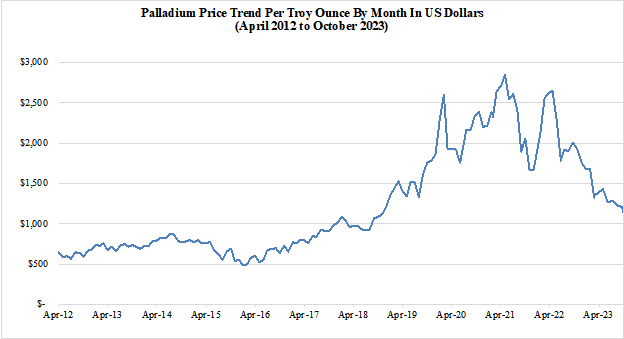
Source: Paumanok IMR “Passive Electronic Components: WMTO 2023-2028.” Palladium is a metal that is used in MLCC electrodes for mission critical applications in high voltage, high temperature and high frequency. Such high feedstock pricing impacts costs to produce for many MLCC small MLCC manufacturers and this is the primary motivating factor behind the movement to alternative electrodes and alternative MLCC designs in many end-markets where it has not been used before such as fossil fuel engine electronics, defense, space and oil & gas electronics.
Ruthenium
Ruthenium is a precious metal that is similar to that of palladium, but its primary purpose is to be consumed in all thick film chip resistors and resistor networks produced worldwide. The price of ruthenium has shown extreme volatility because of its association with palladium mining activities in South Africa. The reader should remember that reliance on ruthenium for all mass-produced thick film chips is a weakness that threatens the entire high-tech economy.
Figure 1.6: Ruthenium Price Trend – 2012-2023
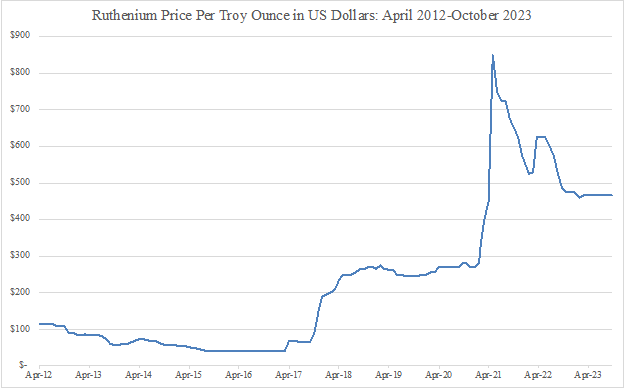
Source: Paumanok “Passive Electronic Components: WMTO 2023-2028.” This price volatility has caused customers to seek alternative resistor designs also based upon thin film nickel. Unfortunately, the economies of scale of manufacturing for thin film resistors are but a small fraction of that of thick film chips, one of the largest volume products produced in the world (measured in the trillions of pieces). Resistors represent a significant volume of worldwide consumption for ruthenium metal (with additional uses as a cracking catalyst, a hard disc drive coating and as an esoteric chemical compounds). Therefore, the metal is very sensitive to any changes in resistor supply and demand the global high tech economy and its signpost on the current market conditions should not be overlooked by the precious metal market analyst.
Tantalum
The majority of tantalite metal used in the production of tantalum capacitors comes from Central Africa. Other known tantalite resources are located in Australia, Brazil and Canada. Tantalite’s primary use is as capacitor grade tantalum metal powder for consumption in capacitor anodes. Tantalum capacitors are consumed in communications networking equipment, smartphones, automotive, medical and defense electronics. Tantalite and tantalum ores have demonstrated volatile pricing in the past but has remained relatively stable in price during the current market shortages. The reader should know that the lessons learned from the tantalum supply chain have been and will continue to be valuable as OEM brands insist on transparency on all material supply chains. Tantalum pricing has been stable in comparison to other dielectric materials for an extended period of time.
Figure 1.7: Tantalum Ore Price Trend: 2012-2023
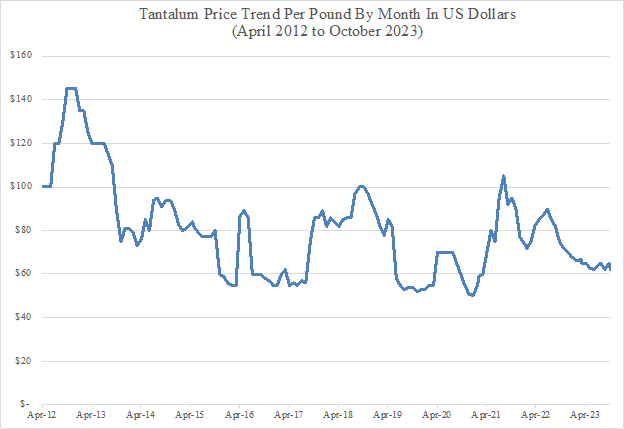
Source: Paumanok “Passive Electronic Components: WMTO 2023-2028.” Paumanok Publications estimates that the primary raw materials consumed in the production of tantalum capacitors are capacitor grade tantalum metal powder and wire, which is engineered from high purity tantalum ores and concentrates. Tantalum, a rare metal, represents a significant portion of the variable costs to produce for tantalum type capacitors.
Silver
Silver is consumed as a termination material for many electronic components but primarily for MLCC that employ precious metal electrodes. MLCCs with precious metal electrodes and silver terminations are in turn consumed in high voltage, high temperature and high reliability MLCCs for similar end-use market segments.
Figure 1.8: Silver Ore Price Trend – 2012-2023
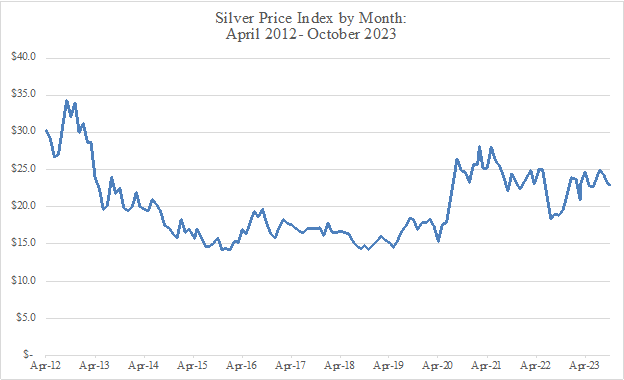
Source: Paumanok Passive Electronic Components: WMTO 2023-2028
Summary and Conclusions: Electronic Materials Markets and Outlook for 2023
Raw materials impact the overall costs to produce passive electronic components and, in fact, dielectric materials, electrode materials and termination materials represent the largest “variable cost” associated with the production of electronic components. Any fluctuation in price or availability for these key feedstocks can have a negative impact on profit margins for electronic component producers, but seldom does a component manufacturer or their customers in OEM and EMS output have long term visibility on the various sub-levels of the supply chain. This article illustrates how multiple materials markets declined in value in October 2023 following months of volatile price variability brought about by inflation, competition and supply chain disruption.
Paumanok Publications, Inc. is the world’s largest supplier of market research and consulting services to the passive electronic component industry. For 35 years, Paumanok has supplied research products and services for trade companies and private equity firms that have a financial interest in, or are directly involved in the supply chain for capacitors, resistors, inductors and circuit protection components as well as the engineered materials and ores associated with their key functions.
Dennis M. Zogbi

Dennis M. Zogbi is the author of more than 260 market research reports on the worldwide electronic components industry. Specializing in capacitors, resistors, inductors and circuit protection component markets, technologies and opportunities; electronic materials including tantalum, ceramics, aluminum, plastics; palladium, ruthenium, nickel, copper, barium, titanium, activated carbon, and conductive polymers. Zogbi produces off-the-shelf market research reports through his wholly owned company, Paumanok Publications, Inc, as well as single client consulting, on-site presentations, due diligence for mergers and acquisitions, and he is the majority owner of Passive Component Industry Magazine LLC.
Search MarketEYE
Filter Articles By Category
TTI Insights
Stay Updated
Keep up with the latest news, product introductions, tech videos, and more.