Definitions, terms & abbreviations are located at the bottom of the page.
Electrolytic capacitors are certain types of capacitors that use an oxide film made of either aluminum, tantalum, or niobium metals as a dielectric to achieve a large capacitance. Electrolytic capacitors are used extensively in power supply circuits to reduce voltage fluctuations in various filtering devices.
Charlese Pollak, a German rechargeable battery manufacturer, invented electrolytic capacitors in 1887 when he realized the importance of the electrolyte to provide neutral or basic stability of an oxide layer. Electrolytic capacitors were originally developed for early radio and telecommunication systems to address the need for high-capacity capacitors. These new capacitors provided a reliable solution for smoothing voltage fluctuations and filtering signals in electronic circuits, thus enhancing the performance and stability of electronic devices.
Electrolytic Capacitor Infographic
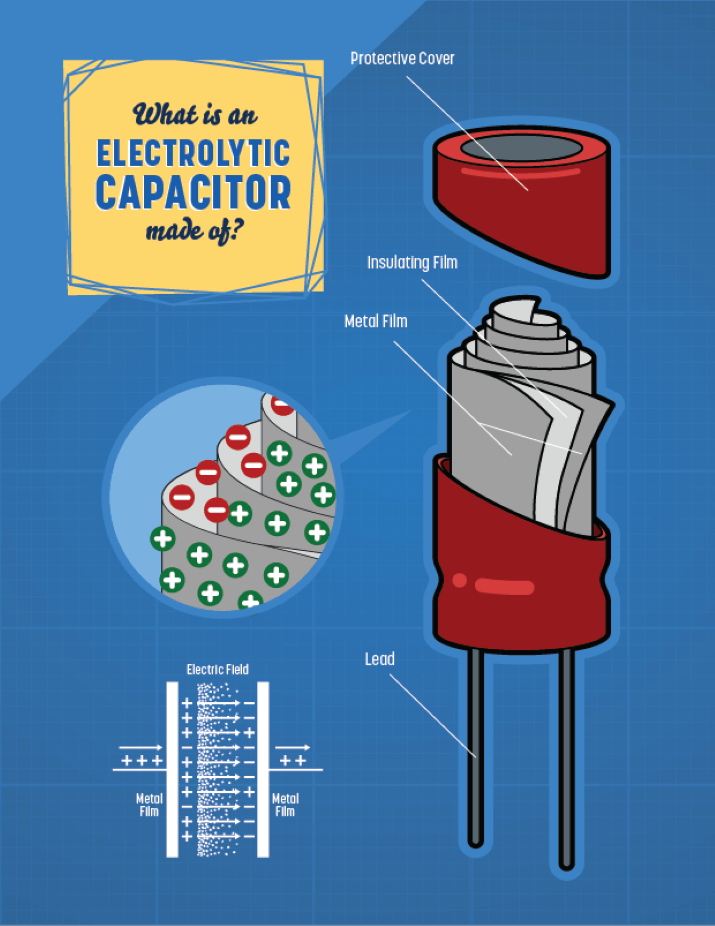
Electrolytic Capacitor Functionality
Unlike regular capacitors, electrolytic capacitors utilize an electrolyte solution to achieve a much higher capacitance value and consist of two main parts: the anode (positive) and the cathode (negative).
The anode of an electrolytic capacitor consists of a highly pure aluminum foil coated with a thin layer of aluminum oxide. This oxide layer acts as the dielectric of the capacitor. Furthermore, the cathode is immersed in a conductive electrolyte paste or solution that enhances the capacitance significantly. Separated by the dielectric oxide layer, the anode and cathode contain a physical and electrical barrier between them.
The anode is first oxidized in the manufacturing process to form the dielectric layer. Afterward, the cathode is treated with the electrolyte paste or solution Voltage is then applied to the capacitor in the correct polarity (positive to negative), and an electrochemical reaction occurs at the anode. This reaction causes the dielectric layer to become even more insulating, enhancing the capacitor's ability to store charge. Due to this electrochemical process, electrolytic capacitors can achieve capacitance values much higher than other types of capacitors.
Electrolytic capacitors have a limited lifespan and can deteriorate over time due to factors like temperature, voltage stress, and aging electrolyte solution. When electrolytic capacitors are used beyond their specified parameters or in poor conditions, they can leak or even explode, causing damage to the surrounding circuitry. Therefore, the proper care and consideration of operating conditions are essential when integrating electrolytic capacitors into electronic designs.
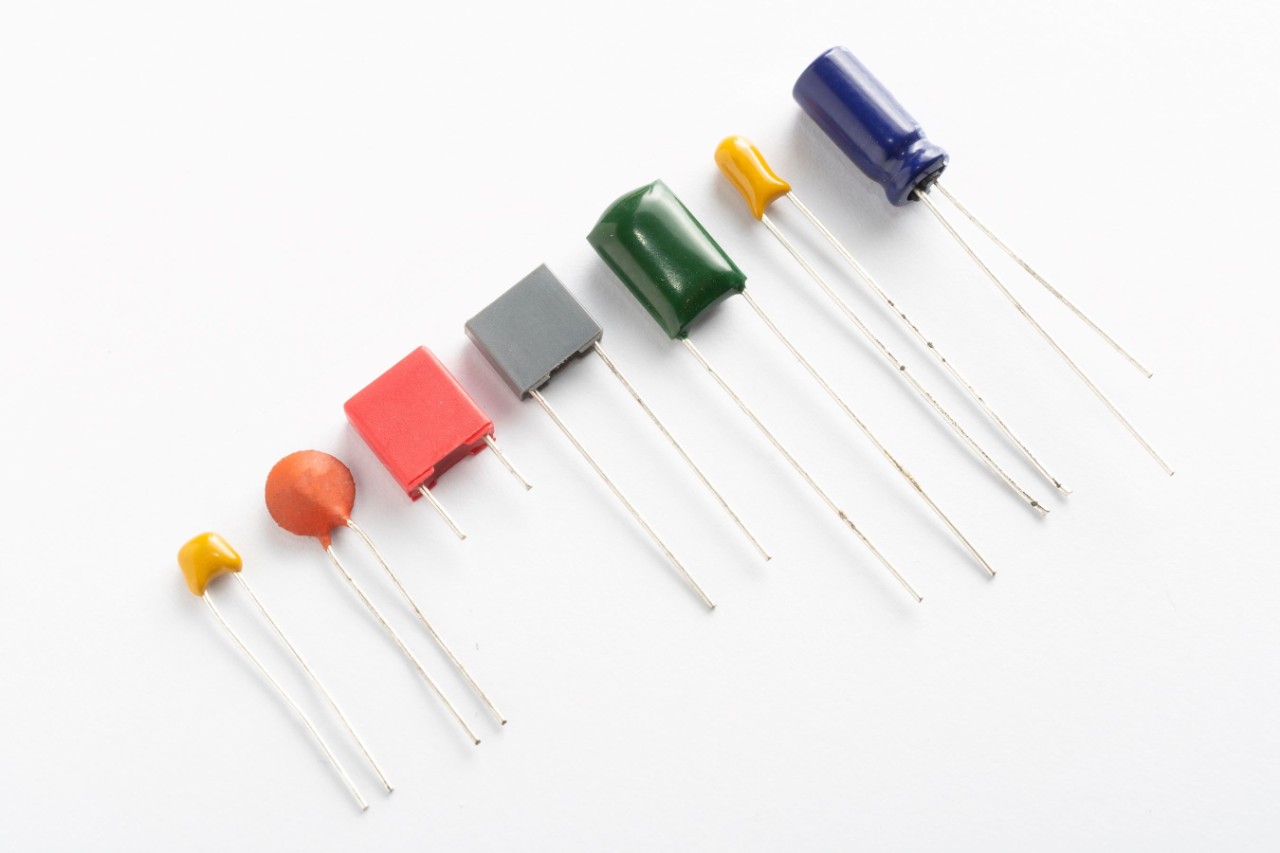 Electrolytic Capacitors are available in a variety of materials for specific application purposes.
Electrolytic Capacitor Composition
Anode: A conductive plate, often made of aluminum foil serves as the positive terminal of the capacitor.
Cathode: Another conductive plate connected to the negative terminal with a special electrolyte paste or solution.
Dielectric Layer: Typically made of aluminum oxide, this layer provides insulation between the anode and cathode while forming on the anode's surface due to an electrochemical reaction.
Electrolyte Paste: A conductive, often gel-like or liquid solution placed between the cathode and the dielectric layer thus substantially enhancing the capacitor's capacitance.
Casing: Usually made of aluminum or plastic, encloses the anode, cathode, dielectric, and electrolyte, providing physical protection and insulation.
Lead Wires: Extend from the anode and cathode, allowing the capacitor to be connected to a circuit.
Markings: Include information such as capacitance, voltage rating, and polarity to aid in the proper usage and identification of electronic circuits.
Additional Materials and Structure
There are three different anode metals electrolytic capacitors use:
- Aluminum capacitors use a high-purity etched aluminum foil with aluminum oxide as dielectric.
- Tantalum capacitors use a sintered pellet "slug" of high-purity tantalum powder with tantalum pentoxide as dielectric.
- Niobium capacitors use a sintered "slug" of high-purity niobium or niobium oxide powder with niobium pentoxide as dielectric.
Aluminum Capacitors May Also Feature:
- SMD "V" vertical chip capacitors
- Axial style
- Radial or single-ended
- Snap-in terminals
- Screw terminals
Tantalum Capacitors May Also Feature:
- SMD capacitors
- Axial style
- Dipped lacquered "pearl" capacitors
Niobium Capacitors May Also Feature:
- Axial style
- Surface mount
- Through-hole
- Solder pads
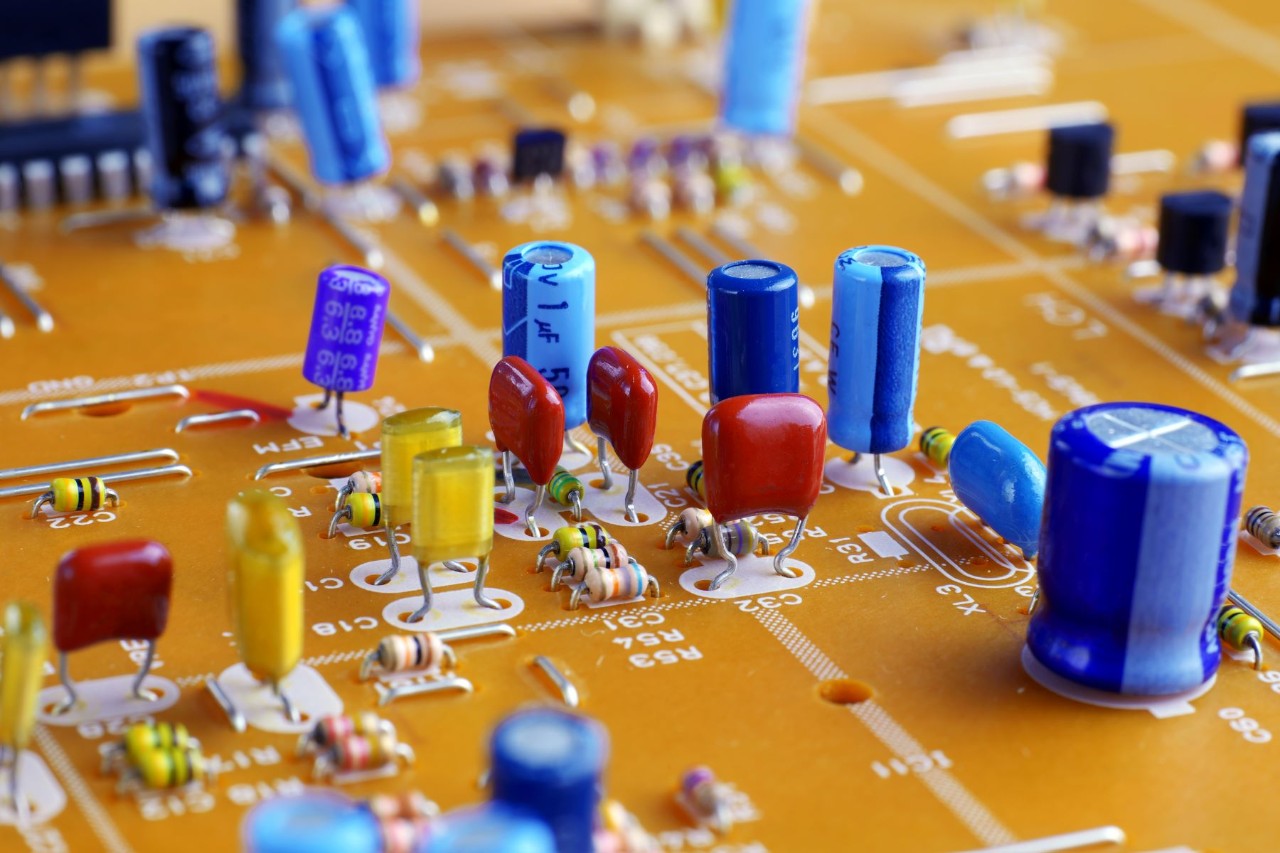 Electrolytic capacitors are applied to circuit boards for regulating voltages
Voltage Specifications
Below are the maximum voltages that can be applied to the electrolytic capacitors without risking damage to a component:
- 6.3V
- 10V
- 16V
- 25V
- 35V
- 50V
- 63V
- 100V
- 160V
- 200V
- 250V
- 400V
It's important to select a capacitor with a voltage rating higher than the voltage it will experience in the circuit to ensure proper functioning and safety.
Key Abbreviations
- μF: A Microfarad is a unit of capacitance representing one-millionth of a farad
- V: Volt is a unit of electrical potential
- WV: The Working Voltage is the maximum voltage the capacitor can handle under normal operating conditions
- DC: A Direct Current indicates that the capacitor is designed for use in circuits with a constant voltage
- AC: An Alternating Current indicates that the capacitor is suitable for use in circuits with shifting voltage
- ESR: The Equivalent Series Resistance represents the internal resistance of the capacitor, affecting its efficiency and performance
- DF: The Dissipation Factor indicates the efficiency of the capacitor in storing and releasing energy
- Ripple Current: The maximum alternating current that a capacitor can handle, particularly important in power supply applications.
Electrolytic Capacitor Applications
- Power Supplies: Electrolytic capacitors are used in power supply circuits to smooth out voltage fluctuations from a source to ensure a consistent power supply for an electric device.
- Audio Equipment: Electrolytic capacitors are used in audio amplifiers and speakers for coupling and decoupling applications, filtering out unwanted noise, enhancing audio quality, and improving signal integrity.
- Motor Starters: Electrolytic capacitors are employed in motor starter circuits to provide the initial boost of power required to start electric motors for various appliances and industrial equipment.
- Lighting Ballasts: Electrolytic capacitors are used in fluorescent and high-intensity discharge (HID) lighting ballasts to regulate the electrical current flowing through the lamp, ensuring a stable and constant light output.
- Switching Power Supplies: Electrolytic capacitors are essential for voltage regulation and filtering in applications such as computer power supplies, LED drivers, and various electronic devices.
- Telecommunications Equipment: Electrolytic capacitors are used for signal filtering and coupling, reducing noise, and securing reliable communication in devices like routers, modems, and network switches.
 Audio equipment enchances and records audio quality
 Wifi routers rely on internal components for effecient signals
 Headlights require a steady flow of electrical current
In Conclusion
Some notable manufacturers of electrolytic capacitors include Panasonic, Nichicon, Vishay, and Kyocera AVX. These manufacturers produce electrolytic capacitors for their fundamental role in stabilizing voltage, filtering signals, and enhancing circuit performance in modern electronic applications. As technology advances, electrolytic capacitors remain essential and crucial components in a world full of electronics.
Looking to buy a particular Electrolytic Capacitor?
If you have any questions, call TTI’s customer support at +49 8142 6680 - 100.
Click here to see all the Electrolytic Capacitor-related products that TTI sells.
- Search all Panasonic Aluminum Electrolytic Capacitors
- Search all Nichicon Aluminum Electrolytic Capacitors
- Search all Vishay Tantalum Capacitors
- Search all Kyocera AVX Niobium Oxide Capacitors