Transportation: The Water Trail of Hydrogen Fuel Cell Technologies
By Dermot Byrne, Industry Marketing Director - Transportation at TTI Europe
Renewable energy sources are crucial for mitigating climate change because they produce energy without depleting finite resources or emitting greenhouse gases. Solar and wind are by far the most widely adopted forms of energy, but others include hydroelectric power from rivers, tidal energy from ocean waves and geothermal energy from heat stored beneath the Earth’s surface.
For many years scientists and engineers have been researching the fuel cell concept. Fuel cells convert the chemical energy of a fuel directly into electricity and heat through an electrochemical reaction. The first practical device was invented by the Welsh scientist Sir William Grove in 1839[1], but it was not until the latter half of the 20th century that fuel cell technology began to gain traction. There are several types of fuel cells, each with its own characteristics and, for this article, we will focus on transportation applications.
Fuel Cell History in the Making
As the name suggests, alkaline fuel cells (AFCs) use an alkaline electrolyte and hydrogen fuel to generate energy. Tom Bacon[2], who was working in the Department of Chemical Engineering and Biotechnology at the University of Cambridge, made the discovery that resulted in the extremely efficient proton exchange membrane (PEM) fuel cells used to power the Apollo 11 mission that led to the famous lunar landing[3], see Figure 1.
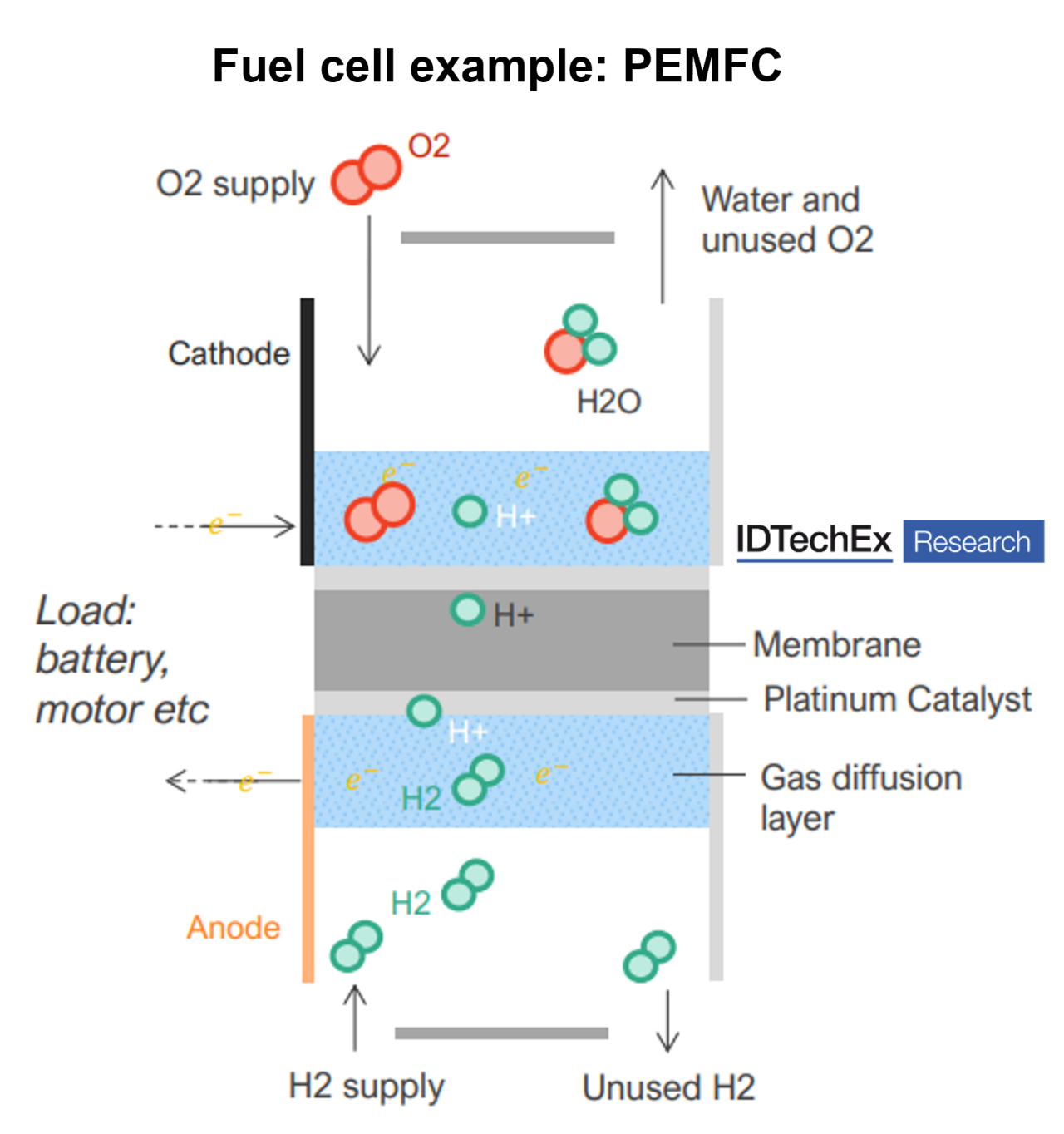
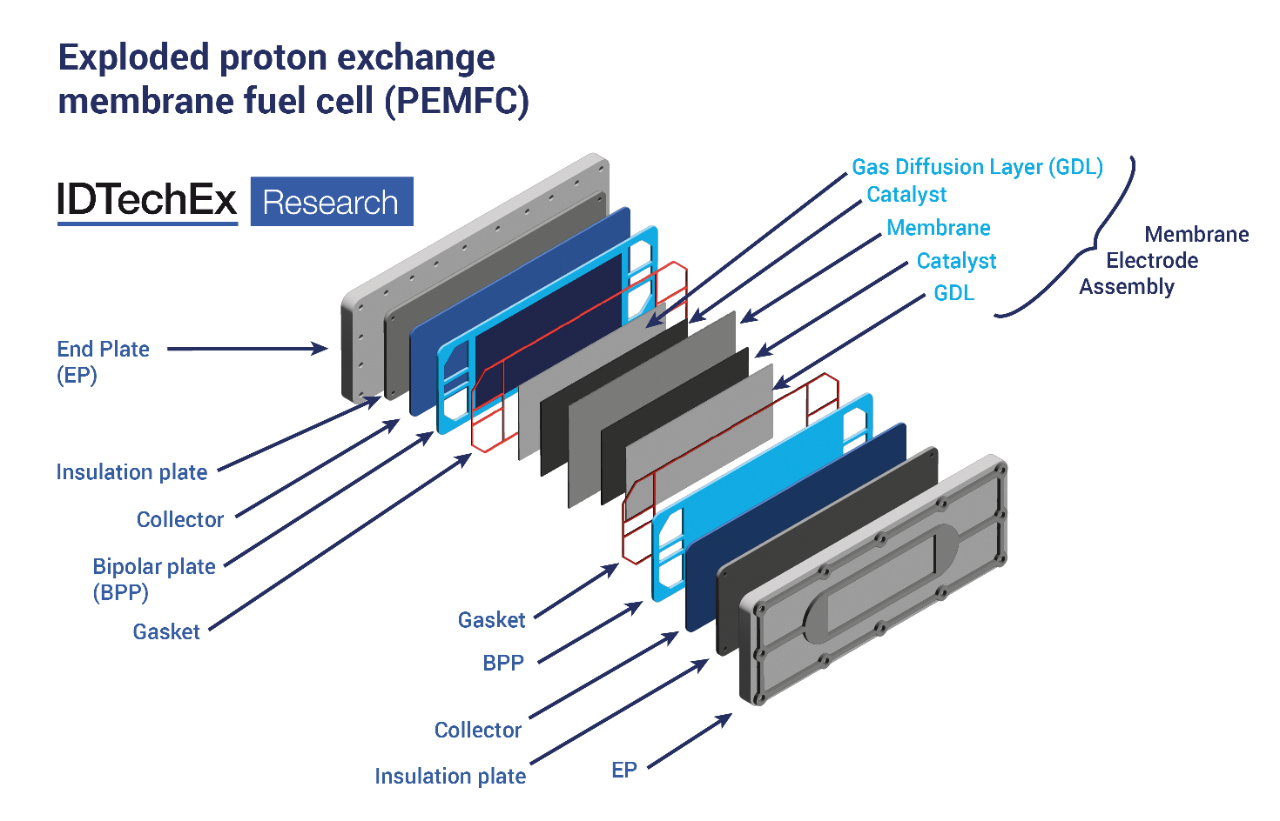 Figure 1: The working principle of a proton exchange membrane (PEM) fuel cell (Source: IDTechEx)
[1] https://www.sciencedirect.com/science/article/abs/pii/037877539080002U
[2] https://www.ceb.cam.ac.uk/news/powering-apollo-11-fuel-cell-took-us-moon
[3] https://airandspace.si.edu/collection-objects/fuel-cell-apollo/nasm_A19780290000
These fuel cells were ideal for powering NASA’s spacecraft since, at the time, they were lighter and less bulky than batteries and more efficient than solar panels. An added benefit was that hydrogen and oxygen were already on board for use as rocket fuel. Furthermore, the only waste product of the reaction was water, which was required on Apollo 11 for the crew to drink – a win-win situation.
Since then, because of their high efficiency, low operating temperature, and rapid start-up capabilities, PEM fuel cells have been further developed for the transportation sector. Today, they are commonly used in fuel cell electric vehicles (FCEVs) applications such as cars, trucks, buses and construction equipment, as well as the marine, rail and aviation industries. There are other fuel cell technologies that do exist, such as phosphoric acid, molten carbonate and solid oxide, but these are mainly used for stationary power applications for off-grid generation and back-up power.
Harnessing Hydrogen
Hydrogen is the most abundant element in the universe, however, in its natural state it is almost always chemically bonded to other elements, such as oxygen in water (H₂O). Therefore, hydrogen needs to be extracted into a pure form through processes like steam methane reforming, electrolysis, or gasification. All these methods require energy inputs, and steam methane reforming and gasification may produce greenhouse gas emissions or have other environmental impacts.
Electrolysis is basically the reverse process that hydrogen fuels cells use – the chemical process separates hydrogen from oxygen in water by applying an electrical current. If the energy for producing hydrogen comes from a wind or solar plant, then hydrogen energy is entirely clean. With the introduction of clean hydrogen, termed ‘green hydrogen,’ it became logical to assign different colours to hydrogen produced using different power sources, see Figure 2.
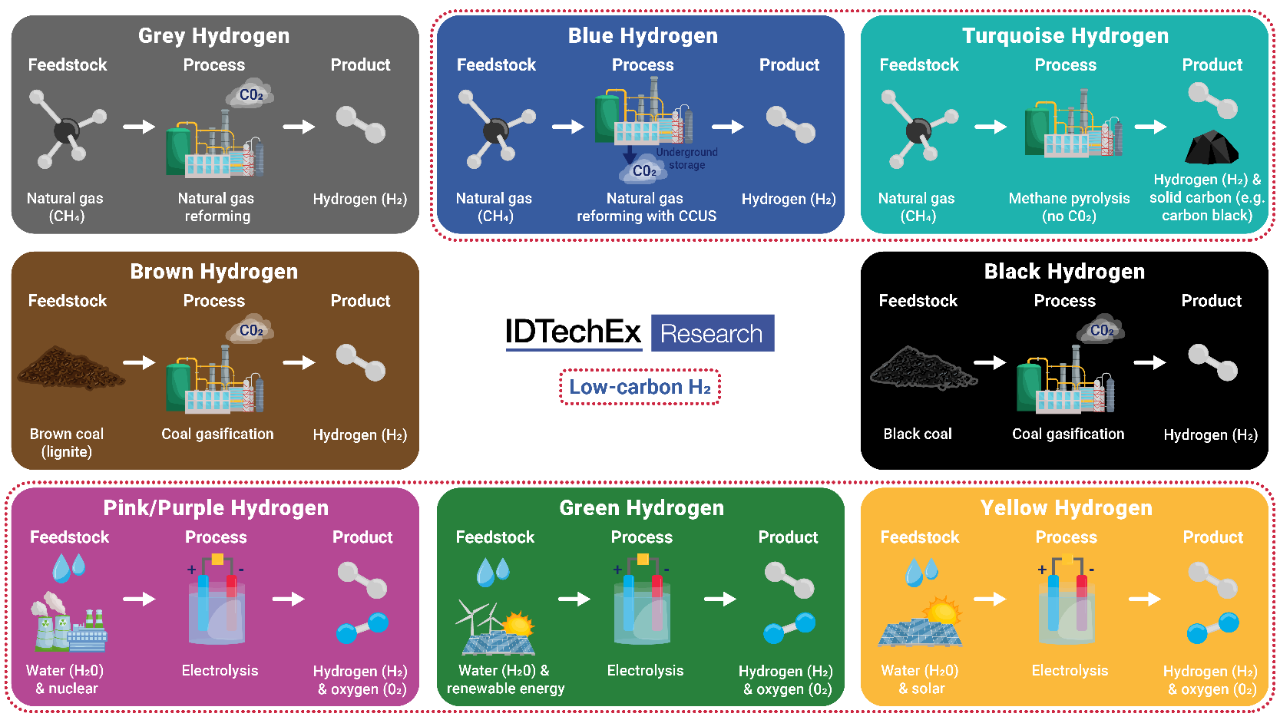 Figure 2: Hydrogen production colours – the lower the carbon content of the process, the cleaner the hydrogen (Source: IDTechEx)
Tremendous progress has been made with electrolysis with industrial-scale low-carbon hydrogen production systems now being deployed. The goal is to produce only green hydrogen with more installations using surplus energy produced by wind and solar farms.
Batteries Versus Fuel Cells
FCEVs generate electricity via an on-board hydrogen fuel cell, which acts as the power source, similar to battery electric vehicles (BEVs), to drive the electric motor that propels the vehicle. In comparison to BEVs, fuel cell systems can offer a high gravimetric energy density (energy stored per unit mass), as pressurised hydrogen stored in tanks is both lighter and more energy dense - this gives FCEVs a significant range and/or weight advantage, while also being zero-emission. In addition, refuelling the hydrogen fuel cell is similar to a traditional petrol or diesel vehicle – just a few minutes.
Although the adoption of hydrogen fuel cell passenger cars faces stiff competition from battery electric vehicles (BEVs), which have seen significant advancements in technology and infrastructure, there is a distinct advantage of using the technology in commercial vehicles. The bus market started adopting hydrogen fuel cells years ago for municipal buses, and this will soon be followed by tourist buses, the attraction being the long distances these FCEVs can travel in comparison with their battery-powered counterparts.
Since then, truck OEMs have started using hydrogen fuel cell technology. The attraction for transportation businesses is that they can meet their carbon emission reduction targets while having trucks with a range similar to that of internal combustion engine (ICE) equivalents – 400km and more. More recently, the construction and mining industries have been taking serious note of fuel cell technologies - not for operational mode when at a standstill but for travelling from point A to point B. The agricultural, marine, rail and aviation industries are also exploring this space.
A hydrogen economy will also necessitate major investment in infrastructure, including storage facilities and distribution networks via pipelines, ships, and transportation vehicles. The hydrogen industry believes it can all be accomplished within a few years provided adequate economic incentives are implemented. Just think, one hydrogen refuelling station can serve more vehicles than an equivalent EV charging station and there is a lower grid electricity demand.
FCEV Design Considerations
When developing a FCEV there are several design considerations encompassing a range of crucial aspects. System architects and engineers developing fuel cell systems will need to consider the connectors' current, voltage, and power requirements, as well as whether they should prefer plastic or metal connection systems. They also need to decide if shielded or unshielded connectors are required, what wire gauge would be needed, choose the system’s IP sealing requirements and decide if ATEX connection technology will be required.
In the process of sensor integration, it's critical to determine the required types of gas sensing for your system. Monitoring the system temperature is also essential for achieving optimal performance. Further considerations involve integrating HV contactors and fuses, as well as assessing the need for emergency or panel-mounted switches.
When it comes to passive components, designers will need to choose between aluminium or film capacitors. Consideration must be given to the types of high-power resistors utilized in the system. Additionally, assessing the necessity of custom magnetic solutions is crucial. Furthermore, determining whether DC/DC or AC/DC power converters are required adds another layer of consideration to the overall design process. Each of these factors contributes to the seamless functionality and safety of the overall system design.
Outlook for FCEV in Transportation
Overall, the FCEV transportation sector is experiencing significant growth and innovation, with major automotive, commercial vehicle and technology companies investing in hydrogen fuel cell technology. As infrastructure for hydrogen production, distribution, and refuelling continues to develop, FCEVs are expected to play an increasingly important role in the transition to sustainable transportation.
Mercedes-Benz is actively developing hydrogen fuel cell technology for heavy-duty truck applications. Ballard Power Systems, a leading provider of fuel cell technology, has partnered with several bus manufacturers worldwide to develop and deploy FCEV buses. Also, Symbio, a French company specialising in hydrogen fuel cell systems, is collaborating with bus OEMs like Safra and Kawasaki Heavy Industries whereas Liebherr and Hyundai Construction are exploring the use of hydrogen fuel cells in construction equipment, such as excavators and loaders.
Key components include HV connectors from TTI suppliers including Amphenol, TE Connectivity, Aptiv and Rosenberger, HV contactors from TE Connectivity, TDK, and Omron. There are also gas, current, pressure, and temperature sensors from brands like Amphenol, Honeywell, TE Connectivity, TDK, among others. Additionally, passive and discrete components play a vital role in the FCEV system’s functionality. And power supplies, though more for green hydrogen production and refuelling stations, are available from Mean Well, Advanced Energy, OmniOn Power and more.
TTI Europe’s local product and technical professionals can help FCEV OEMs navigate the design process, from analysing component trends, sustainable sourcing, and new product roadmaps to in-depth technical support from our engineering experts. Furthermore, connector assembly is one of TTI’s most important value-added services, complemented by a global distribution reach delivering consistent quality and reliability.
About TTI, Inc.
TTI, Inc., a Berkshire Hathaway company, is an authorized, specialty distributor of electronic components. Founded in 1971, the emphasis on a broad and deep product portfolio, available-to-sell inventory and sophisticated supply chain programs have established TTI as a distributor of choice to manufacturers in the industrial, defense, aerospace, transportation, medical, and communications sectors worldwide. TTI and its wholly owned subsidiaries, the TTI Family of Companies, Mouser Electronics, Sager Electronics and Exponential Technology Group employ over 8,000 people in more than 148 locations throughout North America, South America, Europe, Asia and Africa. Globally, the company maintains about 288,000 square meters of dedicated warehouse space housing over 850,000 component part numbers.
For more information about TTI, visit www.ttieurope.com.
Press contact TTI – Europe:
Christine Nohl
Senior Marketing Communications Manager – Europe
Ganghoferstr. 34
82216 Maisach-Gernlinden, Germany
T: +49 (0)8142 6680-493
Email: christine.nohl@de.ttiinc.com
Agency contact Publitek:
Carsten Otte
Account Director
Bremer Straße 6,
21244 Buchholz, Germany
T: +49 (0)4181 968098-80
M:+49 (0)1520 9158629
Email: carsten.otte@publitek.com