Sensor Technology In Battery Management
By Arron Bickerton, Business Development Manager Northern Europe - Sensors, TTI Europe
Over the last five years, many of our suppliers have acquired various disparate types of sensor companies and are now consolidating what technologies they have got and narrowing their portfolio. Today, certain parts are being made obsolete or are entering into last-time buys with an elevated price. With a tighter portfolio of digital products rather than analogue products, digitisation has a major impact on manufacturing structures. In some respects this is causing less flexibility for our customers but, on the other hand, there are a lot of exciting new products coming out at the same time.
Moving forward, we see the biggest growth for TTI being digital sensors that consume very low power and are considerably smaller in size; however, describing all the potential use cases would be a major exercise. Instead, this article focuses on the automotive one and, more specifically, how the combined use of various different sensor technologies, known as sensor fusion, is supporting battery management systems (BMS) and the entire drivetrain in electric vehicles (EV).
While most of today’s EV battery architectures are at 400V, the heat generated by the latest DC fast chargers can overheat the batteries, which is one of the reasons why charge speeds tend to drop after 80%. To unlock significantly faster-charging speeds, OEMs have moved to 800V architectures so the battery receives more power from the charger buts at a lower current. The lower current also reduces resistance losses, thereby improving thermal efficiency and stopping the battery from potentially overheating. The other benefit at the EV charging point is that the charging cables can be of the same thickness since only the voltage increases, not the current, reducing cable cooling requirements.
Other EV powertrain trends include range extension, which can be significantly enhanced by developing an efficient and effective BMS that dynamically balances the cells while the car is being driven and charged. EV batteries have a very slender ideal operating temperature window of between 20-40°C – anything outside of these limits can have a big impact on battery degradation and reduce the EV’s range. Another element is safety. If the battery runs too hot, the chemical reactions within the battery accelerate, which could ultimately lead to thermal runaway.
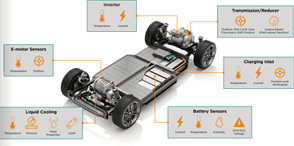 Figure 1: Electric vehicle powertrain sensors (credit TE Connectivity)
The advancement towards smarter, more efficient, and safer critical systems is made possible by sensors. The most common sensor types utilised within the EV powertrain are for monitoring temperature, pressure, position, fluid properties, fluid level, gas concentration, current and speed. Let’s look at the key application areas and highlight which sensing solutions are applied to the vehicle to ensure it operates safely and prolongs the battery life.
Battery pack: EV battery packs are complex and their design and layout differ widely by OEM. Generally speaking, they consist of a cluster of individual batteries, each containing hundreds of cells connected together. Battery pack condition monitoring is essential to check the overall state of health of the battery. Temperature sensors are attached to the outer casing to monitor the overall thermal performance of the battery pack, ensuring it remains within the safe thermal limits.
Thermal runaway: If the battery cells exceed the allowable operating temperature, they could catch fire or, worse, explode. When this occurs, the fire can propagate and spread to other cells within the battery pack; this is called thermal runaway. The chief causes of thermal runaway include a short circuit, both internal and external, over charging/discharging, external heating or self-heating. The primary indicators for cell failure are loss of cell voltage, heat generation, gas generation, build-up of internal gas pressure, swelling of the cell, and smoke generation. Again highly accurate temperature sensors are used to monitor the temperature of the cells, along with pressure sensors to detect transient increases in pack pressure as cell gases vent into the battery pack environment. There are also gas sensors, including H₂ and CO₂ sensors, to detect gas emissions and particulate sensors to detect smoke.
Cell connection system: Used as the top cover of the battery cell, the cell connection system provides connectivity with the battery management system (BMS). Here, temperature sensors are used to ensure that the system is operating within the defined temperature limits.
Power inverter/electric motor: The high voltage DC from the battery must be converted to low voltage AC to drive the electric motor. Here, a combination of temperature sensors for thermal management and current sensors for applications like overload protection is needed. In addition, high-speed rotary inductive position sensors are used to accurately measure the rotor position to efficiently drive the EV traction motor.
High voltage charger connector: During charging, a combination of temperature and current sensors are used to ensure that it does not overload or overcharge and that the connector does not overheat. In addition, a position lock verification sensor is used to confirm a secure connection.
Motor coil: Within the motor, wire coils generate a magnetic field and conduct electric current. The interaction between the two rotates the motor’s shaft, thereby converting electrical energy into mechanical energy. Here, temperature sensors are interlaced into the wire windings to ensure that the motor is operating within defined thermal limits.
Battery coolant system: Within the battery, coolant circulates around the battery cells to maintain the optimum battery temperature. Temperature sensors, pressure sensors, and ultrasonic level sensors are used. In addition, combined temperature and pressure sensors are available that provide both pressure and temperature measurements in one assembly.
Conclusion
While the sensor industry is consolidated and technologies are changing from analogue to digital, TTI is here to support its customers. TTI Europe stocks a wide range of sensors from suppliers, including Honeywell, Amphenol, TE Connectivity, and more. Whether it is calibration effort for temperature or pressure sensors, custom designs to meet specific architectures and control systems, or advice on what’s happening within the sensor market, TTI’s technical team is readily available to provide technical advice and guidance.
Image rights:
Figure 1: TE Connectivity
About TTI, Inc. – Europe
TTI, Inc., a Berkshire Hathaway company, is an authorized, specialty distributor of electronic components. Founded in 1971, the emphasis on a broad and deep product portfolio, available-to-sell inventory and sophisticated supply chain programs have established TTI as a distributor of choice to manufacturers in the industrial, defense, aerospace, transportation, medical, and communications sectors worldwide. TTI and its wholly owned subsidiaries, the TTI Family of Companies, Mouser Electronics, Sager Electronics and Exponential Technology Group employ over 8,000 people in more than 148 locations throughout North America, South America, Europe, Asia and Africa. Globally, the company maintains about 288,000 square meters of dedicated warehouse space housing over 850,000 component part numbers.
For more information about TTI, visit www.ttieurope.com.
Press contact TTI – Europe:
Christine Nohl
Senior Marketing Communications Manager – Europe
Ganghoferstr. 34
82216 Maisach-Gernlinden, Germany
T: +49 (0)8142 6680-493
Email: christine.nohl@de.ttiinc.com
Agency contact Publitek:
Carsten Otte
Account Director
Bremer Straße 6,
21244 Buchholz, Germany
T: +49 (0)4181 968098-80
M:+49 (0)1520 9158629
Email: carsten.otte@publitek.com