Power Supplies and Actuators for KNX Building Automation Systems
By Chris Perkins
Energy savings, interconnected devices, cost savings and more functionality could be in the headline for many articles on new technology but these factors really do come together when building and home automation is considered. For example, as long ago as 2010, energy savings from building automation were predicted to be up to 41% [1] and with technology advances that could be even more today with connected devices.
To achieve benefits in homes and commercial properties, heating, ventilation and air conditioning (HVAC) needs to be actively controlled, linked in with other functions such as lighting and security. Controllers, actuators and sensors from multiple sources may need to be interfaced and an effective way to do this is through the ‘KNX’ bus [2], a world-wide standard for home and building automation control.
KNX bus logic states
Although the KNX bus can be implemented wirelessly, over powerline or IP/Internet, the most common method is via a simple 2-wire twisted pair, interconnecting all of the system modules. Devices on the bus communicate at 9600 baud rates with a logic ‘1’ on the bus defined as ‘do nothing’ or a continuous positive bus voltage, typically 30V, and logic ‘0’ as a waveform superimposed on the bus by a transmitting device shown in Figure 1. Receiving devices have logic which interprets the waveform from different sources to enable data collision avoidance and half-duplex bi-directional communication.
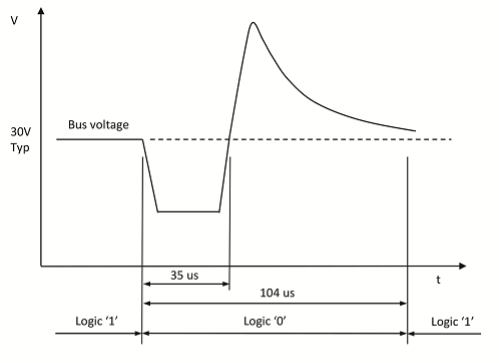
Figure 1: logic states on a KNX 2-wire bus
The 2-wire KNX bus can be seen as simply a power supply rail that is ‘pulled down’ by transmitting devices for logic zero, in fact devices can also take their operational power from the bus if a low value. The waveform required can be derived from a power supply on the bus which has an inductor in series with the output. The initial dip is caused by a controlled current sink from the transmitting device – this is not overloading the power supply; it is the effect of Faraday’s law - voltage drop across an inductor is proportional to the rate of change of current through it. The positive swing is also the same effect when the sink current stops, as the energy in the inductor is discharged into the impedance of the bus connection.
Power supply solutions
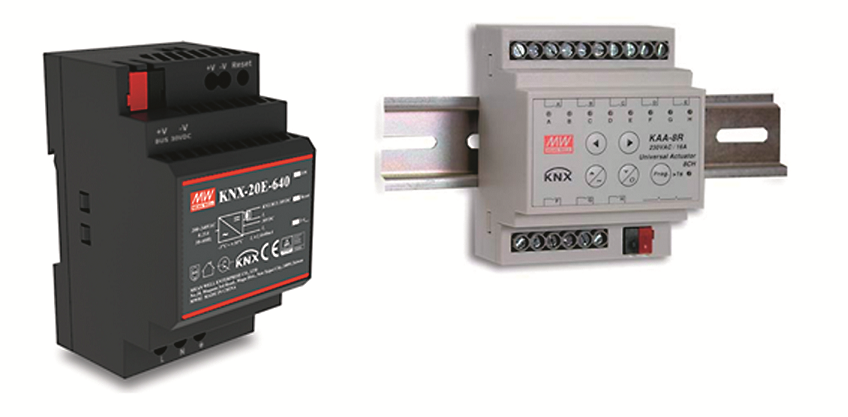
Power supplies for KNX bus applications must normally fit in distribution cabinets on ‘DIN-rails’ with standard unit (SU) widths in multiples of 18mm. One solution from Meanwell is their KNX-20E-640 product (Figure 2) which at just 3 SU width and 30V/640mA rating, can support up to 64 KNX devices. A larger version rated at 1280mA KNX-40E-1280 is just 4 SU or 72mm width for up to 128 devices. Both products incorporate the output inductor necessary for KNX compatibility as well as a second auxiliary output which can be used to supply constant power to other devices. Both types feature comprehensive fault protection.
Actuator solutions
Actuators are one of the many device types that connect to a KNX bus, responding to data ‘telegrams’ on the bus to drive isolated relay outputs which in turn switch loads such as lighting, motors and heaters. Actuators will typically be DIN-rail mounted with multiple output channels. The Meanwell KAA-8R series (Figure 2) is an example of an 8-channel actuator with 10A or 16A relay contact ratings in a 72mm (4 SU) width. A particular feature is the use of latching relays that do not need to be continuously driven. This keeps power consumption low at less than 180mW, enabling the part to be powered directly off the KNX bus. The relay contact ratings are fully characterised with appropriate derating according to EN 60669-1 for different load types, inductive, such as with motors or capacitive as with electronic lighting ballasts.
KNX systems are recognised world-wide as the ideal solution to interconnection of a diverse range of building automation products enabling energy and installation cost savings. Safety is enhanced as well with low voltage signalling on reduced numbers of cables compared with older systems, mitigating fire hazards. Cost-effective power supplies and actuator products from Meanwell are designed as a perfect fit for the application.
Meanwell KNX products are available from their distributor TTI Europe [4].
References
[1] D. Gyalistras, M. Gwerder, F. Oldewurtel, C. Jones, M. Morari, B. Lehmann, K. Wirth, and V. Stauch, “Analysis of energy savings potentials for integrated room automation,” in 10th REHVA World Congress
[2] www.knx.org
[3] https://www.meanwell.com/productPdf.aspx?i=120
END