Transportation
The Future Of Transportation is Now
In the not-too-distant future, transportation will become part of the Internet of Moving Things. Connected vehicles will meet Smart Cities, ships will be controlled remotely by GPS, and wireless devices like radios and computers will be enabled by Positive Train Control. At the intersection of technology and possibility, experts anticipate demanding, interesting design challenges.
Whatever type of design, whatever part of the design process—TTI has Transportation Specialists ready to help keep you moving into the future. TTI has been a trusted electronic component distributor for over 40 years because of the industry's broadest inventory of interconnect, passive and electromechanic products, and the specialists who know all about it.
Electro-mechanical
An electromechanical component is one that uses an electrical signal to perform a mechanical task, such as a motor turning. These changes typically require an electrical current to create a magnetic field, which causes a physical movement. This category then may include switches, circuit breakers and relays (of all kinds), as these actions often require a mechanical switch, although some solid-state relays are also available. The options are endless, as many electromechanical components require a user interface, which can also be customized. In addition, there are circuit breakers which also act as switches. Whether you require small form, toggle, pushbutton, tact – TTI has the right electromechanical parts in stock.
Interconnect
Interconnect is a broad term that includes all different types of connectors. There are many types of connectors available to support the automotive and commercial vehicle markets. These connectors are available in various forms and each type has a unique construction, function, and benefit.
Agricultural Machinery
Connectors for agricultural machinery often require high-quality, lightweight plastic, with superior resistance to harsh environments and high-vibration. Connectors for agricultural vehicles and equipment provide these benefits and more. These products are highly reliable in engine, transmission and braking systems. Sealing grades of up to IP69K are available, and products include circular, rectangular power and signal connectors. These connectors are easily harnessed and field-serviceable, and they can also be customized to fit specific customer needs.
Construction Equipment
Construction equipment manufacturers worldwide rely on TTI's broad range of high-quality, harsh environment connectors. These are offered in both plastic and metal versions. They are designed specifically to withstand harsh environments, and are resistant to vibration, fluid and dirt. These connectors can also provide superior sealing capability up to IP69K. Options include circular and rectangular versions, as well as PCB styles. Metal circular connectors are available in power and signal types with mixed layouts.
Electrification
There are a range of high-performance connectors available at TTI that meet the demand of modern vehicle electrification and related applications. These connectors offer high-current and optimized sizing for vehicle electrification. TTI carries Aptiv, Amphenol, Kostal and TE high voltage connectors. These connectors safely conduct high currents and voltages from battery to the inverter to the electric motor. The touch-proof 2-position/3-position connectors and headers are engineered with 90-degree and 180-degree plugs and feature integrated internal HVIL function and EMI shielding. Each connector product family features a wide range in temperature and various wire types, as well as multiple keying options for use in hybrid and electric vehicle applications. Assembly is simplified with a lever assist for low insertion force.
Automotive
TTI offers automotive solutions across engine management and control, exhaust monitoring and cleaning, infotainment and communications, in-car power, lighting, safety and security systems, navigation and telematics systems. In addition, TTI carries advanced technology solutions for hybrid-electric vehicles.
Passives
Passive components like resistors, capacitors, and magnetics often get far less attention in comparison to active components, as passives are expected to do one thing, do it well, and do it under difficult circumstances.
System reliability requires that all individual components work “to spec” across the entire operating spectrum of temperature, vibration, and contaminants. For this reason, engineering a reliable passive device which meets the stringent automotive-segment mandates is more involved than just paying modest attention to electrical and mechanical details.
For designers, there’s much more to selecting an automotive passive component than checking that it is “qualified.” It’s also a matter of asking “qualified for what?” There is no single minimum auto standard; instead, the industry has defined levels of ruggedness for the various settings within the vehicle. For example, the under hood stress situation is far different than the in-cabin environment.
High Voltage
Around the world, governments are announcing mandates that will bring about the demise of the internal combustion engine. China has led the charge by requiring 8 percent of new vehicles on the road to be “new energy” or zero emission vehicles in 2018, a huge growth over the current 2 to 3 percent on the road today. Similar strong government regulations limiting the future of the internal combustion engine have passed around the world, allowing the hybrid and fully electric automobile industry to continue gaining momentum. Furthermore, North America, (namely Canada and the US), is expected to be the second largest market for electric trucks.
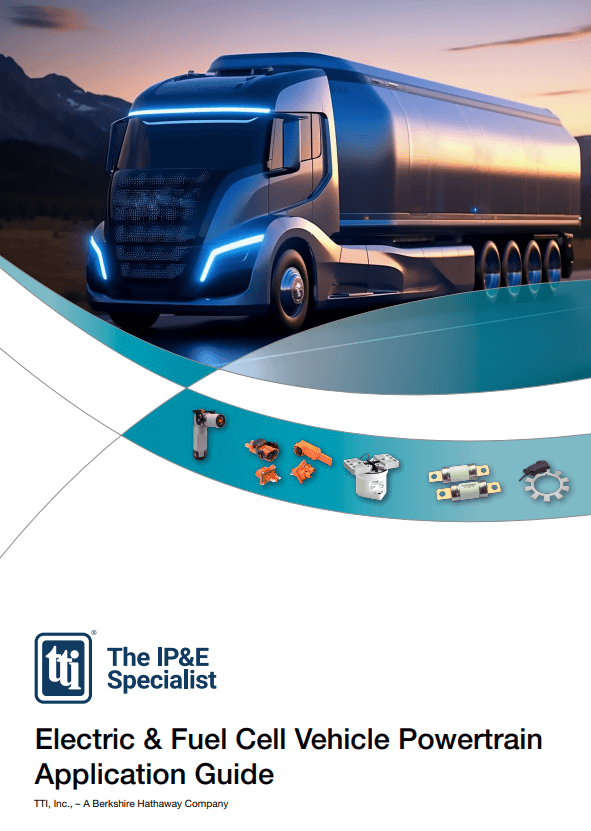
New entrants like Tesla and Nikola are expected to disrupt the North American market, while Chinese manufacturers are eyeing export markets to uphold market dominance, particularly electric truck sales. The electric powertrain adoption is poised to accelerate post 2020 due to the fall in battery prices. From connectors to capacitors to circuit protection, TTI is heavily invested in the high voltage and the electrification trend.
Sensors
With sensors designed for the future, transportation continues to improve. Communication technologies such as dedicated short-range communication (DSRC), vehicle-to-vehicle (V2V), and vehicle-to-infrastructure (V2X) are allowing transportation to become safer, more efficient, connected, and data savvy. Through DSRC and V2X technology we can drastically decrease traffic accidents, ease traffic congestion, and conserve fuel. These advantages don't stop with cars. Construction vehicles, commuter trains, off-road vehicles, tractors, and public safety vehicles also have a growing need for updated sensor technology in the near future.
Electrification
Most electric motors are designed to be efficient at generating torque and horsepower. As a result, most are not as symmetrical as they could be as if they were designed to be generators as well. The regenerative braking energy needs to mate well with the battery charging technology. As battery charging technology continues to improve, so does regenerative braking. .
Manufacturers are now designing modern electric motors for use with hybrid vehicles. Expect performances up to 2500 Newton-Meter torque ratings and 8000 RPM rotational speeds. Established motor companies can provide these capabilities, as well as the ability to design custom motor/generators. Keep in mind that costs must be kept low.
Power electronics are key. Whether acting as traction motors or generator brakes, ultra-low resistance connectivity, cabling, and electrical control systems for loads like 1200A of currents are not trivial, especially when the working voltages can range from 24 to 750V DC or more.
Excerpted from: Not Your Daddy's Hybrid: Next Generations Rival the Best, by Jon Gabay for Mouser Electronics.
While aspects of vehicle electrification may seem like fads with limited impact, electric vehicles themselves are well on their way to commercial acceptance. They are seen as a mature solution to reducing greenhouse gases, pollutants and traffic in densely populated areas. Whether we like it or not, fossil fuels are finite – there is a future where they will no longer exist for transportation as we see it, electrification can improve this prediction today.
Autonomous Driving
Self-driving vehicles in one form or another represent the future of automotive transportation, potentially saving lives and allowing many more vehicles to share a crowded highway system. As self-driving vehicles mature, the technologies that will control and sense the world around these vehicles remain in question. LIDAR – a combination of light and radar – has come to dominate this discussion, with a wide range of supporters, but one very notable detractor.
LIDAR works similarly to radar systems. Instead of a radar wave, it shoots focused laser beams into its environment and measures the time the reflection takes to return. With this data, it then obtains a point cloud of the surrounding area, letting the autonomous vehicle “see” its surroundings, not as an image but as a 3D model—as if creating a video-game-world based on the car’s surroundings, with the car itself inside.
Other technologies attempt to imbue vehicles with the same perception, but do so with different technologies such as vision sensors (cameras), ultrasound sensors, and radar. Each of these has advantages and disadvantages.
Excerpted from: Almost Everyone Thinks LIDAR is the Technology Choice for Self-Driving Cars, by Jeremy Cook for Mouser Electronics
Connected Vehicle
Emerging trends highlight the role of the connected vehicle in transportation, but vehicles are poised to become an essential platform for personal mobility. In combination with personal electronics, the connected vehicle will redefine the mobile experience, bringing the separate capabilities of mobile device and vehicle together into a single, safe, personalized environment.
Some of the most promising opportunities for extending mobile-device functionality lie in the ability of connected vehicles to use their powerful resources to complement these devices for services such as navigation. Vehicles can take advantage of their size and ready power sources to provide a more sensitive signal-reception platform or complement that platform with advanced inertial measurement unit (IMU) devices able to track location in the absence of GPS signals. Similarly, connected vehicle platforms can offer resources to buffer large data sets such as detailed route maps—both speeding performance and filling in data gaps found in GPS or cell coverage. Just as important, vehicle platforms can support the additional navigation-design complexity required to resist accidental or intentional interference including navigational signal spoofing.
Excerpted from: How Connected Vehicles Will Safely Leverage Smartphones, by Stephen Evanczuk for Mouser Electronics
Rugged Vehicles
The commercial vehicle market consistently requires stronger defenses against hazards such as temperature, vibration, and exposure to moisture or chemicals, all of which can cause failure. As a result, suppliers are developing ruggedized connectors that meet stringent requirements and ratings. Connector manufacturers are taking advantage of slower demand in the heavy-duty Class 8 truck and bus markets to make significant investments in new product development, aggressively going after market share and preparing for a market uptick by introducing forward-thinking products. At the center of most of this innovation is harsh environment performance.
Excerpted from: Connector Innovations for Commercial Vehicles, by Lee Iken for TTI Inc.
Rail & Transit
Whether designing for the transportation of passengers or freight by bus, light rail, heavy rail, commuter rail, or steamship – safety, cost efficiency and reliability are paramount. Today’s passengers expect interlinked mobility chains and payment systems and virtual real-time scheduling. Freight owners require real asset tracking. New rail designs incorporate the latest technological innovations such as microprocessor-controlled brake and propulsion systems, data bus configuration for information and control transfer between cars, an onboard microprocessor maintenance diagnostic system, digital controlled voice and signage, and positive train control compliance. Remaining competitive in this market is complex and requires the application of leading edge electronic component technology, interconnect systems and electromechanical devices.